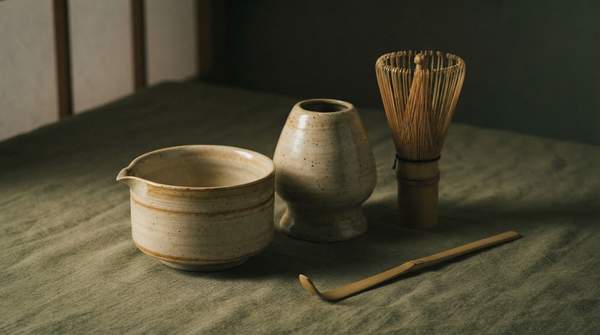
The three central utensils of the Japanese tea ceremony—the chawan (tea bowl), the chashaku (tea scoop), and the chasen (bamboo whisk)—are not merely equipment for making tea. Their materials, forms, and handling are deliberate physical expressions of the ceremony's guiding principles: wabi-sabi, mindfulness, and simplicity. A bowl's uneven rim, a scoop's choice of bamboo over ivory, and a whisk's fragile tines each carry meaning that the ritual depends upon.
The Philosophy of the Japanese Tea Ceremony: More Than Just Tea
The meaning of the ceremony is often traced to Sen no Rikyu, the sixteenth-century figure credited as its founder, who held that the tea ceremony means being present in the moment and recognizing that every moment occurs only once. His philosophy is known as ichi-go ichi-e—one time, one meeting—roughly translatable as "cherish every moment" or a once-in-a-lifetime chance. As the tea-culture educators at Maikoya explain, the ceremony "is not about the taste. It is all about enjoying the moment and remembering that this moment will never repeat."
Rikyu is also credited with popularizing the wabi-sabi style of ceremony, which that same account glosses as "simple is the best." Within this framework, utensils stop being tools and become integral parts of the ritual. Writers at Katachiware, a Japanese tableware specialist, note that each utensil "has its own symbolic significance, and is imbued with meaning that extends beyond the physical object." The chawan in particular is carefully selected to match the occasion and the season, its shape, size, and color chosen to create a specific atmosphere and convey a particular message.
Chawan: The Tea Bowl as a Canvas for Wabi-Sabi
The chawan is where wabi-sabi becomes most visible. An exhibition of tea ceremony ceramics from Connecticut College's Asian art collection describes how the aesthetic appears in these wares through "uneven edges; cracks and chips; glazes and patterns," making the ceramics both a physical representation of wabi-sabi as an aesthetic practice and a manifestation of the underlying Japanese value. During the Momoyama period, kilns across Japan produced Iga, Oribe, and Raku wares—stylistically different, yet united under the umbrella of wabi-sabi aesthetics.
Raku bowls are perhaps the clearest case, because the artist surrenders control over the final appearance during firing. That uncertainty, in the college exhibition's account, "truly embodies the wabi-sabi idea of welcoming flaws and mistakes and dismissing the illusion of control and idea of perfection." Handmade teaware in general carries the visible evidence of its creation: unlike machine-made ceramics, handcrafted bowls display the subtle variations of human touch and natural firing, as the tea specialists at Senbird Tea describe. Master potters, according to Best Matcha's glossary, create vessels with deliberate asymmetry, rough textures, and natural glazes—prioritizing authentic character over technical perfection. Even the bowl's foot ring (kodai) matters compositionally, determining how the bowl rests and sits, and its texture affects both how the tea froths and how the bowl feels in the hands.
Chashaku: The Tea Scoop's Balance of Formality and Simplicity
The chashaku, used for scooping and measuring tea, shows how a single material choice can encode an entire aesthetic position. Ivory has historically been a valued material for tea scoops, and in the hierarchy of utensils ivory scoops are classified as shin—formal, the highest rank—distinguishing them from bamboo scoops associated with wabi aesthetics. The same scoop can therefore signal either formality or rustic simplicity, depending on what the host intends for the gathering.
Selection is itself a cultivated skill: the choice of chashaku for a gathering depends largely on its poetic name, and its shape is designed to match the size and shape of the chawan it accompanies. The way the tea is scooped and measured, Katachiware's guide notes, is a reflection of the host's knowledge and skill. A small bamboo implement thus carries a double burden—communicating the desired aesthetic before the tea is even prepared, and demonstrating the host's mastery in the handling itself.
Chasen: The Bamboo Whisk and the Fragility of Connection
The chasen, the bamboo whisk used to mix the tea and ensure proper frothing and consistency, carries the ceremony's most intimate symbolism. Katachiware's guide describes it as "not just a tool for mixing the tea, but is also a symbol of the connection between the host and the guest. The delicate tines of the whisk represent the fragility of the relationship, and the care with which it must be treated."
That fragility is physical as well as metaphorical. The whisk's delicate tines are essential to the preparation process, and they demand the same attentive, deliberate handling that the ceremony asks of every action. In this sense the chasen condenses the whole ritual into one object: a natural material, shaped by hand into fine strands, that only works when treated with care. The whisk cannot be used roughly or carelessly, and neither, by its symbolism, can the relationship it represents.
Utensils as Embodiments of Tea Ceremony Philosophy
Placed side by side, the three utensils reveal a consistent pattern: each design choice—material, form, or manner of use—maps onto a specific philosophical principle rather than mere convenience.
| Utensil | Function | Material & Form | Embodied Principle |
|---|---|---|---|
| Chawan (tea bowl) | Holds and presents the tea; centerpiece selected to match occasion and season | Ceramic, hand-shaped, often with uneven edges, cracks, chips, and natural glazes; foot ring (kodai) is compositionally decisive for how the bowl rests and sits | Wabi-sabi: imperfection and authenticity valued over perfection; Raku bowls exemplify this through the artist's loss of control in firing |
| Chashaku (tea scoop) | Scoops and measures the tea; chosen partly by its poetic name; the manner of scooping reflects the host's knowledge and skill | Traditionally bamboo; ivory historically valued—ivory classified as shin (formal), bamboo associated with wabi aesthetics | Formality versus wabi: the material choice directly communicates the desired aesthetic |
| Chasen (tea whisk) | Mixes the tea, ensuring proper frothing and consistency | Bamboo, with delicate tines essential to the preparation process | The fragile connection between host and guest, and the care the relationship requires |
The comparison shows that nothing here is arbitrary. A single piece of bamboo carved into tines, a scoop made of bamboo rather than ivory, a bowl whose cracks are welcomed rather than hidden—each is a direct expression of the ceremony's core values, moving beyond mere functionality.
Embracing the Philosophy Through Utensils
To fully appreciate the Japanese tea ceremony, one must recognize that its core utensils are not just tools, but tangible expressions of profound philosophical principles like wabi-sabi and ichi-go ichi-e. The consistent thread across these accounts is that intentional imperfection and natural materials are central—not flaws to be tolerated but the very point of the objects.
A deeper understanding of the ceremony's meaning is achieved when observing the intentional design, material choices, and respectful handling of the chawan, chashaku, and chasen. The next time you encounter a tea gathering—or a single Raku bowl in a museum—look for the uneven edge, the bamboo rather than ivory, the fine tines handled with care. Those observable details are the philosophy, made visible.
Sources
- TEA CEREMONY IN JAPAN — Tea Ceremony Japan Experiences MAIKOYA
- Ultimate Guide To Japanese Tea Ceremony Utensils — Katachiware
- Wabi-Sabi: The Art of the Imperfect in Japanese Tea Ceremony Ceramics – Asian Art and Architecture — DILUO
- Wabi-Sabi (侘寂) Meaning: The Japanese Philosophy of Imperfection in Tea - Senbird Tea
- Wabi-Sabi: Beauty in Imperfection and Impermanence — Best Matcha