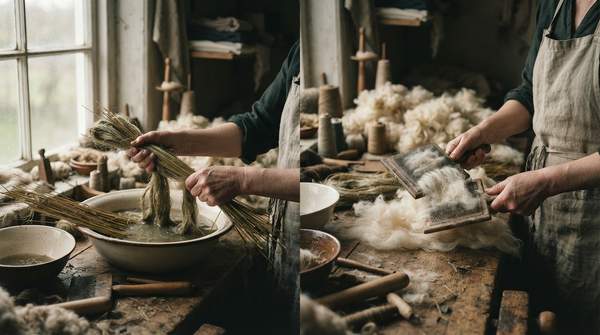
Every natural textile begins with a single decisive question: where in the plant or animal does the fiber live? If the answer is "locked inside a plant stem," as with flax and hemp, the fiber must first be freed through retting, a biological or chemical loosening of the stalk. If the answer is "already loose," as with cotton's seed-borne fluff or a sheep's fleece, the work is instead mechanical: carding, which disentangles and aligns the fibers for spinning. This article explains why the fiber's source dictates its first processing step, and how that step echoes through the finished cloth.
The Diverse World of Natural Fibers: Why Preparation Matters
Natural fibers fall into three primary groups by origin—plant-based, animal-based, and mineral-based—and their morphological architecture and microstructure are, as a review of natural fibers in sustainable materials puts it, fundamental to understanding their performance and optimizing their processing. The crucial distinction for preparation is structural. A scientific review of bast fiber retting observes that unlike cotton or wool, which "come in individual and separate forms with little impurity," bast fibers are "by nature intimately bonded to the matrix material in specific structures and tissues of the plant stem," a bonding that "requires great effort during separation process of the fibers."
That single difference explains why the traditional preparation toolkit splits into two families. One family—retting in its various traditional forms—exists to break a fiber out of a composite structure. The other—combing and carding—exists to organize fibers that are already free but tangled, matted, or mixed with debris. The fiber's origin, in other words, is not trivia; it is the engineering specification for the first machine or microorganism that touches it.
Retting: Unlocking Bast Fibers from Plant Stalks
Retting addresses the specific problem of bast fibers: the useful cellulose fibers of flax and hemp are embedded in the stem's woody matrix, bound by cementing substances that hold the whole structure together. Retting is the biological or chemical process that degrades those binding materials so the fibers can be separated from the stalk. Without it, the fiber simply cannot be accessed in usable form—the stalk remains a stalk.
The logic is one of controlled decomposition. Where cotton arrives from the seed boll as discrete, nearly clean fibers, flax arrives as a whole plant whose fiber bundles are woven into tissue. The retting step is therefore not cleaning in the ordinary sense but liberation: it converts a structural composite into a collection of workable fibers. This is also why retting has historically demanded judgment and effort—the separation must proceed far enough to free the fiber, and the review's emphasis on the "great effort" of separation reflects how stubbornly the plant holds its fibers. Traditional retting methods, rather than modern industrial or chemical variants, are the focus here; enzymatic and steam-explosion approaches fall outside this article's scope.