Sashiko, the Japanese embroidery technique whose name evokes “little stabs” of the needle, began not as decoration but as survival. Born among the working classes of Edo-period Japan (1603–1867), it used simple running stitches to patch, reinforce, and insulate clothing that households could not afford to replace. Today it survives as a decorative art and a meditative craft, and its designs fall into two main families: moyōzashi, built from long lines of running stitches, and hitomezashi, built from single stitches aligned on a grid. Understanding that distinction is the key to reading almost any piece of Sashiko work.
The Enduring Craft of Sashiko: From Necessity to Art
In its earliest form, Sashiko was pure utility. Worn-out clothes were pieced together into new garments with simple running stitches, and the embroidery itself made the resulting textiles stronger and more durable, as the encyclopedic record of the craft notes. Layers of old fabric were stacked onto jackets to extend their life or add warmth where it was needed most.
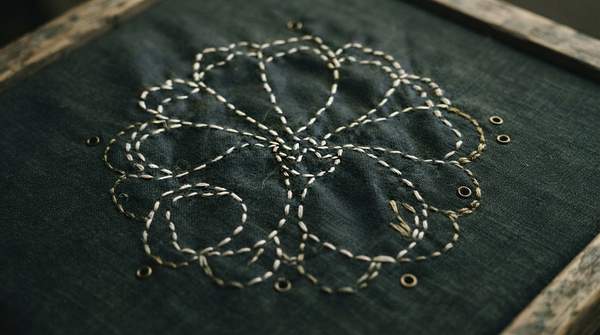
What began as reinforcement gradually acquired a visual identity of its own. Because white cotton thread and indigo-dyed blue cloth were relatively cheap and abundant in historical Japan, Sashiko developed its signature look: white embroidery on blue fabric, though some decorative pieces also use red thread. Even though most Sashiko uses only a plain running stitch, the technique came to be used for repeated decorative patterns and for purely decorative purposes, including quilts and embroidery samplers. Textiles mended layer upon layer until they took on a dense, sculptural character are known as boro, and they embody mottainai, the Japanese sensibility that refuses waste.
The craft’s trajectory, then, is not a simple story of decoration replacing function. The same stitch that once held a farmer’s jacket together now forms geometric patterns on contemporary textile work, carrying its history of thrift into an era when visible mending has found new audiences.
Edo Period Origins: Mending, Warmth, and Mottainai
The conditions that produced Sashiko were political as much as economic. During the Edo period, the Tokugawa shogunate enforced a policy of isolationism, known as sakoku, alongside a strict social hierarchy. Trade with other countries was heavily restricted, so access to essentials like fabric and fiber was limited, and homespun cloth was labor- and time-intensive to produce. For the working class, mending clothing to extend its life became an essential daily task, as the textile historian Claudia Martinez recounts in her history of the craft.
Sumptuary laws added another constraint. The shogunate dictated what different groups could wear in order to cement class separation, prohibiting commoners from wearing luxurious fabrics such as silk and outlawing bright colors and elaborate embroidery, which were reserved for the intricate silk kimono of the upper class. Working people were limited to white, blue, gray, and brown, and their decorative stitching could be no larger than a grain of rice.
Out of these constraints, Sashiko was born. Patches of old fabric were sewn onto worn areas of a garment with a running stitch, both repairing it and thickening it against the cold. The craft’s regional roots ran deep in the rural north: the Tōhoku region, where cotton was scarce and costly, is credited as the technique’s cradle, used there to reinforce, patch, and warm garments. The philosophy underneath it all, mottainai, gave repair a moral weight: to mend a garment was to honor the resources already embedded in it.
The Two Pillars of Sashiko Patterns: Moyōzashi and Hitomezashi
Although Sashiko designs appear endlessly varied, nearly all of them are geometric, and they fall into two main styles distinguished by how the stitch itself is deployed. Moyōzashi patterns are created with long lines of running stitches; hitomezashi patterns emerge from the alignment of single stitches made on a grid. That single difference in construction produces two very different visual worlds.
Hitomezashi stitching is made up of small straight stitches, with the pattern growing out of their accumulation. Because the stitches are dense, the technique adds extra strength to the fabric it covers, which is why it has traditionally been used to reinforce areas that take a lot of wear, such as knees, elbows, and collars, as well as for small decorative details. PieceWork magazine’s Adeline Panamaroff describes hitomezashi as “the more colorful and complex-looking cousin of sashiko,” noting that as it is often seen today it is a more colorful and complex, yet simpler to execute, form of the craft. Both, she emphasizes, remain traditional mending methods of Japan’s historic peasant class.
Moyōzashi works differently. The larger designs are built by stitching a repetitive pattern of simple straight stitches in lines across the fabric, typically working all the horizontal lines first, then the vertical, then the diagonal. This style is usually used to bind two or more layers of fabric together, much like quilting with big stitches, which is how it earned its historical role in layered, warmth-adding garments.
Comparing Moyōzashi and Hitomezashi: The Two Main Sashiko Styles
The clearest way to distinguish the two styles is to set their construction methods side by side and trace each to its visual result. The table below classifies them on that basis: moyōzashi’s continuous running stitches produce flowing lines across larger designs, while hitomezashi’s individual grid stitches accumulate into dense, lattice-like textures.
| Style | Stitch Construction | Visual Characteristic | Purpose and Function |
|---|---|---|---|
| Moyōzashi | Long lines of continuous running stitches, worked in horizontal, vertical, and diagonal passes | Flowing, interconnected lines forming larger overall repetitive designs | Binding two or more layers of fabric together, like quilting with big stitches; adds warmth and reinforcement |
| Hitomezashi | Single small straight stitches aligned on a grid; the pattern grows from their accumulation | Dense, lattice-like texture; often more colorful and intricate in appearance | Reinforcing high-wear areas such as knees, elbows, and collars; small decorative details |
Read this way, any Sashiko piece becomes identifiable at a glance: if the design reads as continuous lines sweeping across the cloth, it is moyōzashi; if it reads as a field of tiny stitches whose arrangement forms the pattern, it is hitomezashi. A third regional tradition, kogin, uses counted-thread diamond patterns, and some accounts treat it alongside the two main families, though the two-style division of moyōzashi and hitomezashi remains the standard framework.
Embracing Sashiko: A Timeless Practice of Utility and Beauty
Readers interested in textile arts or sustainable practices should explore Sashiko as a craft that combines historical utility with modern aesthetic and meditative value. Its patterns are not arbitrary ornament: each of the two main styles encodes a different working method, a different relationship between thread and fabric, and a different chapter of the same history of scarcity, repair, and respect for materials that shaped the Edo-period countryside.
The measurable indicator of that exploration is concrete: increased interest in visible mending projects or the creation of Sashiko-inspired decorative items. A first repaired garment, a sampler of running-stitch lines, or a small grid of single stitches is enough to put the distinction in this article to the test, and to join a tradition that began with a needle, a scrap of old cloth, and a refusal to waste.
Sources
- Sashiko - Wikipedia — EN
- A Brief History of Sashiko — Snugglymonkey
- Exploring Hitomezashi and Practicing Patience — PieceWork