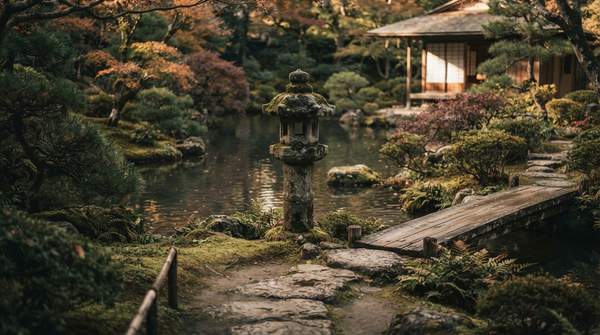
Traditional Japanese gardens are built from three essential physical elements—stone, water, and plants—arranged according to aesthetic principles such as miniaturization and seasonality. Together, these components compress vast natural landscapes into a limited space, producing a carefully composed work of natural art intended to inspire calm, renewal, and contemplation. Nothing in the garden is merely decorative: each stone placement, watercourse, and seasonal bloom serves the philosophical goal of expressing nature's essence and connecting the visitor to it.
The Essence of Japanese Garden Design
The tradition rests on a yearning that the Brooklyn Botanic Garden traces across fourteen centuries of landscape art: the desire "to experience our essential oneness with nature." Like landscape painting and haiku, Japanese garden design developed as a response to the beauty of the natural world and to human culture. The gardens that result are described as traditional designs accompanied by Japanese aesthetics and philosophical ideas, avoiding artificial ornamentation and highlighting the natural landscape itself.
That philosophical grounding is what separates the garden from a decorative planting scheme. Writing for the Portland Japanese Garden, Will Lerner describes a garden's "magic" as "a synthesis of nature and human mind," pointing to its ability to change our perspective and find beauty and wonder in the world around us. In this view, gardens offer more than plants—they provide renewal, inspiration, and a connection to nature. The design aims to foster contemplation and appreciation rather than display.
Foundational Elements: Stone, Water, and Plants
Anderson Japanese Gardens identifies the three essential elements plainly: stone, which forms the structure of the landscape; water, representing life-giving force; and plants, which provide color and change throughout the seasons. Secondary elements—pagodas, stone lanterns, water basins, arbors, and bridges—support the composition, but the core trio carries the garden's meaning.
What unites the three is how they are handled. Japanese gardens are, in Anderson's phrasing, "very carefully designed and patiently pruned according to aesthetic principals" to create natural art that inspires calm, renewal, discovery, and an invigorated soul. The elements are therefore best understood not as materials but as instruments: each is chosen and placed to evoke a specific effect within a larger idealized vision of nature.
Stone: The Garden's Enduring Structure
Stone supplies the garden's skeleton. Rocks form the fundamental structure of the landscape, representing mountains, islands, and other natural landforms within the composition. Because stone is permanent, it anchors the miniature geography that the rest of the garden elaborates.
The materials themselves carry meaning. Japanese garden designers generally use worn, aged materials to suggest a natural landscape and to express the fragility of existence as well as time's unstoppable advance. A weathered rock does more than fill space; it compresses geological time into a single object. Ancient Japanese art inspired past garden designers in this approach, and the restraint matters: Fine Gardening warns that ostentatious stone groupings can give the viewer "a sense of uneasiness, which is the opposite of our goal." Subtlety—less is more—governs how stones are grouped and placed.
Water: Symbolism and Serenity
Water represents the life-giving force of the landscape, and it is an important feature of many gardens, alongside rocks and often gravel. Its treatment is deliberately scaled down: a cascade or waterfall is a miniature version of the waterfalls of Japanese mountain streams, bringing the sound and movement of a remote mountain gorge into a garden's bounds.
The classical manual Sakuteiki, as summarized in the Wikipedia article on Japanese gardens, describes seven kinds of cascades and advises that a cascade should face toward the moon where possible, designed to capture the moon's reflection in the water. It also notes that cascades benefit from being half-hidden in shadows. Water's representation varies with garden style: in dry gardens, raked gravel stands in for water, preserving the symbolism of movement and flow without a single drop. Whether literal or implied, water introduces life, motion, and reflective calm into the composition.
Plants: Evoking Nature's Cycles and Forms
Plants provide the garden's color and its changes throughout the seasons. Selection emphasizes natural appearance and seasonal variation—texture, form, and color are chosen to reflect natural landscapes rather than to showcase exotic specimens. Fine Gardening cautions against overpowering a garden with too many specimen trees, which produces unease rather than tranquility.
Seasonality is not incidental to planting choices; it is a design principle in itself. In Japanese art, the cycle of seasons is a cultural prism that reveals universal order and the impermanence of existence, influencing profound emotions about life's passing stages. This deep cultural importance of seasons extends directly into garden design. Each season is equally important, and plants are chosen to highlight these changes, so the garden presents a different look throughout the year—a continuous, unfolding aesthetic interest rather than a single moment of bloom.
Core Design Principles: Miniaturization and Seasonality
Two principles bind the elements together. The first is miniaturization: elements are arranged to represent vast natural landscapes within a limited space, creating a miniature, idealized view of nature. The cascade that shrinks a mountain waterfall is the same logic that lets a hermitage garden—a small garden built by a retiring samurai or government official devoted to study and meditation—hold a pond, a rock garden, and the features of traditional gardens in miniature, designed to create tranquility and inspiration.
The second is seasonality: the garden's design intentionally incorporates plants that highlight seasonal change, ensuring a different aesthetic character across the year. Where miniaturization compresses space, seasonality unfolds time. Together they let a bounded garden express nature's essence—its scale and its cycles—at once.
Elements and Principles: A Framework for Japanese Garden Design
The framework below maps each physical element to the principle that governs its use and the aesthetic goal it serves, showing how tangible components produce intended abstract effects.
| Element | Guiding Principle | Symbolic / Aesthetic Goal |
|---|---|---|
| Stone | Structure and form | Forms the garden's fundamental framework, representing mountains, islands, and other natural landforms; worn, aged materials express time's unstoppable advance. |
| Water | Life and movement | Symbolizes the life-giving force; a cascade is a miniature mountain waterfall, ideally catching the moon's reflection; raked gravel represents water in dry gardens. |
| Plants | Texture, form, and seasonality | Chosen for natural appearance and seasonal variation, reflecting natural landscapes and providing a different look in each season. |
| All elements | Miniaturization | Represent vast natural landscapes within a limited space, creating a miniature, idealized view of nature. |
| All elements | Seasonality | Seasonal changes are intentionally integrated, so each season brings a distinct aesthetic character. |
| Overall design | Philosophical goal | Highlighting the natural landscape to evoke peace, tranquility, and a connection with nature. |
Read across the rows, the table makes the central relationship visible: stones, water, and plants are not ornaments but vehicles for principles. A rock grouping is a mountain range; a cascade is a mountain stream; a maple is the turning of the year. The framework is what turns a list of features into a readable composition.
Cultivating Contemplation: The Enduring Purpose of Japanese Gardens
To appreciate a traditional Japanese garden, focus on how its core elements—stone, water, and plants—are intentionally arranged to embody principles like miniaturization and seasonality, reflecting nature's essence and inviting contemplation. Rather than scanning for familiar props, read the garden as a compressed landscape: identify what the stones represent, whether water is literal or suggested by gravel, and which plants are carrying the season.
The measurable indicator of this understanding is a visitor's ability to identify the symbolic meaning of elements and the design principles at play within a Japanese garden, leading to a deeper sense of tranquility and connection to nature. A garden read this way stops being scenery and becomes what the tradition intends: a small, idealized nature that renews the viewer, one carefully placed stone and one turning season at a time.
Sources
- Authenticity in Japanese Landscape Design - Brooklyn Botanic Garden
- Tranquil Simplicity: Exploring the Meaning of Wabi Sabi in Portland Japanese Garden – Portland Japanese Garden
- What Makes Japanese Gardens Unique? - Anderson Japanese Gardens
- Japanese garden - Wikipedia
- Elements of a Japanese Garden - Fine Gardening