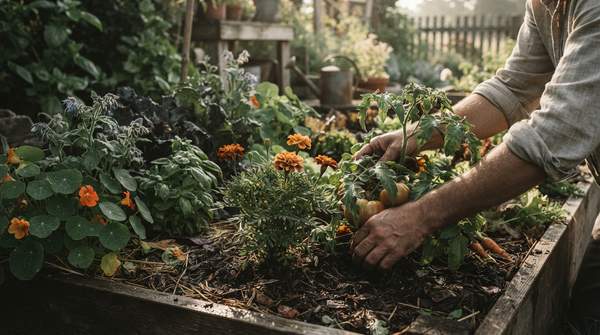
Companion planting—the practice of placing vegetables, herbs, and flowers near one another so that each does the other some good—is an old idea that heirloom gardeners still lean on, and a workable planning chart can be built from it today. The strongest pairings work through a handful of identifiable mechanisms: deterring or confusing pests, drawing in predatory and pollinating insects, improving growth and flavor, fixing nitrogen, and physically occupying ground that weeds would otherwise claim. The pairings below draw on a mix of long-standing garden tradition and, in a few cases such as buckwheat near squash, research that has begun to test the old claims directly. Effectiveness still varies with climate, soil, and local pest pressure, so treat the chart as a starting hypothesis rather than a guarantee.
Core Principles of Effective Companion Planting
Behind nearly every traditional pairing sits one of a few ecological mechanisms, and knowing which mechanism is at work tells you how much confidence a recommendation deserves. The first is pest deterrence: strongly aromatic plants are held to mask the scent of a crop or repel its attackers outright. Denver Urban Gardens' companion planting guide, for example, lists borage as a companion to tomatoes, squash, and strawberries that deters the tomato worm; catnip planted in borders to deter flea beetles; and chives set around the base of trees to discourage insects from climbing the trunks.
A second mechanism is growth and flavor enhancement—a more traditional category of claim. The same guide credits chamomile as a companion to cabbages and onions that improves their growth and flavor, chives as a companion to carrots with the same effect, and beebalm as a tomato companion that improves growth and flavor. Caraway, the guide adds, can be planted "here and there" to loosen the soil. These are the claims gardeners have repeated for generations; they are plausible and low-risk, but they rest on accumulated observation rather than controlled trials.
Third is soil enrichment and nutrient sharing, where the underlying biology is well established. Legumes such as peas and beans fix nitrogen, which is why Mary's Heirloom Seeds recommends pairing cauliflower with peas and beans to supply that heavy feeder's nitrogen appetite. The companion planting reference hosted by Northern Gardener adds a related principle: plants with long taproots, like burdock, draw nutrients from deep in the soil and enrich the topsoil to the benefit of shallow-rooted neighbors. Nutrient cycling, in other words, can run vertically through a bed as well as between neighboring root systems.
Finally, there is spatial strategy. Sprawling crops planted alongside tall, upright ones minimize the open areas where weeds typically take hold, according to that same reference—an arrangement that pairs naturally with heirloom gardening's fondness for mixed beds rather than monocultures. The classic model that combines several of these principles at once is the Three Sisters grouping of corn, beans, and squash: structural support, nitrogen fixation, and ground shading in a single planting, a combination long valued for its resilience.
One caution belongs with the principles rather than the chart, because it shapes every layout decision: companion benefits are crop-specific. Dill, according to the Denver Urban Gardens guide, improves the growth and health of cabbage yet dislikes carrots. Fennel is disliked by most plants and should be kept away from the garden entirely. A plant that is a model neighbor for one bed may be a poor one three rows over.