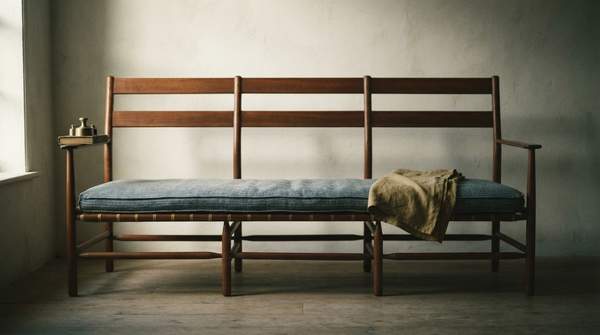
Shaker furniture's spare, unadorned look is not a style choice but a physical expression of religious conviction. The Shakers—formally the United Society of Believers in Christ's Second Appearing—built chairs, tables, and storage around three guiding principles of honesty, utility, and simplicity, and every distinctive feature, from a chair that hangs on a wall peg to a cupboard built into the room itself, traces back to those values and to the practical demands of communal living. Understanding that connection lets you read a piece of Shaker furniture the way its makers intended: as a record of what they believed and how they lived.
The Spiritual Roots of Shaker Design
The Shakers established farming communities in Kentucky, Maine, Ohio, and Pennsylvania, living according to principles of pacifism, gender equality, celibacy, and consensus. As the Metropolitan Museum of Art's essay on Shaker furniture explains, celibacy was part of Shaker orthodoxy, which meant Believers had to recruit from the outside world to keep their communities from dying out. Within those communities, careful design ensured that every physical aspect—buildings, tools, and furniture—reflected the cherished qualities of modesty, purity, and simplicity.
This is the crucial starting point: austerity was devotional, not decorative restraint for its own sake. As Encyclopaedia Britannica describes it, the Shakers held that "to make a thing well was in itself an act of prayer," and that the appearance of a thing should follow upon its function. Work itself carried an ethical dimension; the Encyclopedia of Design notes that the Shakers believed work could be a form of devotion, so furniture became a visible expression of disciplined communal life. The objects we admire today in museums were, for their makers, acts of worship.
Shaker Design Principles: Simplicity, Utility, and Honesty
The defining quality of Shaker furniture, as the Encyclopedia of Design frames it, is "the disciplined removal of anything that does not serve structure, use or spiritual propriety." The Shakers avoided applied carving, elaborate veneers, pictorial ornament, and fashionable excess, favoring instead proportion, repetition, symmetry, and carefully resolved details. Britannica adds that most superfluous decorations, such as inlays and moldings, were eliminated, and that each item was fashioned solely to serve its intended use.
Economy was also a spiritual matter. According to the account of Shaker design history published by Maharam, the Shakers designed everything to be made as economically as possible; anything superfluous, such as decoration, was avoided, and standardized shapes—mostly squares and circles—were used. Honesty ran through the work as well: Britannica characterizes the designs by "an austerity of decoration and truth to materials," meaning construction and wood were presented as they were, without disguise. The result is furniture renowned, in the Metropolitan Museum's words, for its minimalist design and unstinting quality.