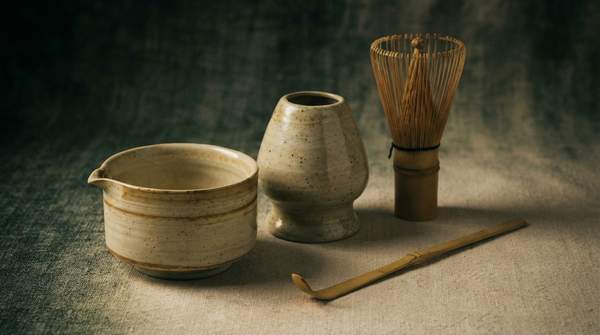
Japanese tea ceremony utensils are not merely functional tools for making matcha—they are physical expressions of the ceremony's philosophy. Each of the three core utensils used to prepare and serve tea—the chawan (bowl), the chashaku (scoop), and the chasen (bamboo whisk)—embodies the aesthetic of wabi, the appreciation of simplicity and imperfection, and the mindful attention that defines the ritual. Understanding how their materials and design choices carry these ideas reveals why the utensils are treated as integral to the ceremony rather than incidental equipment.
Introduction: Utensils as Philosophical Guides in the Tea Ceremony
The tea ceremony, or chanoyu, is described by cultural guides as far more than an occasion for drinking tea: it is a practice of cultivating mindfulness, respect, and tranquility. Katachiware, a Japanese tableware specialist, notes that each utensil used in a ceremony has its own symbolism and is carefully selected to create a sense of harmony and balance. Natural materials such as bamboo and ceramic, the same guide explains, reflect the importance of nature in Japanese culture. The utensils are therefore read as part of a ritual that represents a deeper understanding of Japanese aesthetics, not as background props to it. In the basic temae—the portion of the ceremony in which tea is made and served—three utensils do the essential work: the bowl that holds the tea, the scoop that measures it, and the whisk that blends it.
Historical Evolution: From Status Symbols to Wabi Simplicity
The philosophical character of these utensils was not always present; it emerged through a documented shift in taste. The Spurlock Museum's account of tea culture traces the chashaku as a case study. Originally imported from China, the earliest chashaku were known as shin style and were crafted from ivory or gold to display status among the upper class. Over time, tea practitioners sought a simpler design, favoring the bamboo scoops of the gyo style, a design introduced by the artist Jo-o. His version featured a distinctive node near the curved tip—a subtle bend that the museum reads as embodying the wabi philosophy of imperfection.
A parallel story applies to the chawan itself: the museum notes that Japan initially imported these bowls from China and Korea for their craftsmanship, owing to a lack of domestic kilns capable of producing them. What began as imported display goods became, over generations, deliberately humble objects.