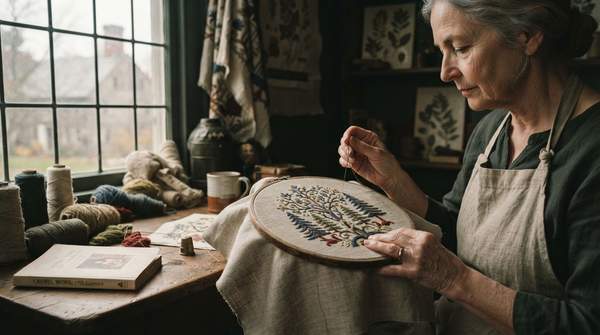
Crewel embroidery is defined less by any single stitch than by its material: two-ply worsted wool yarn worked on a sturdy ground fabric, in a free style of embroidery rather than a counted-thread technique. That definition, traced by reference works on the decorative arts, stretches back to at least the eleventh century, and the craft's story is best understood as a sequence of stylistic periods rather than one continuous tradition. Its most celebrated chapter is the Jacobean era of seventeenth-century England, followed by a leaner colonial adaptation in America, a decline during industrialization, and a series of revivals stretching into the twentieth century.
The Enduring Art of Crewel Embroidery: A Historical Journey
What makes crewelwork distinctive is the interplay of a humble material with ambitious design. The wool yarn gives the stitched surface a raised, textured quality that EBSCO's research overview describes as producing designs that often resemble paintings, with a three-dimensional character that flat silk or cotton threads rarely achieve. Because the technique is free embroidery, the embroiderer follows a drawn or transferred design rather than counting threads, which allows sweeping curves, large leaves, and flowing vines.
The craft is most often associated with England in the seventeenth and eighteenth centuries, and emigrants carried it from England to the American colonies, where it took particular root in New England. Its fortunes rose and fell with the economies of households: where wool and leisure were abundant, designs grew elaborate; where both were scarce, as in the colonies, the same technique produced a visibly different style. That responsiveness to circumstance is precisely why a chronological lens serves the reader better than a general one.
From Ancient Origins to Jacobean Splendor
Crewel embroidery's documented English history reaches back to the eleventh century, but its golden age arrived in the seventeenth. During the reign of King James I (1603–1625), needleworkers embraced what became known as the Jacobean style, a term the Embroiderers' Guild of America notes is often used interchangeably with crewel itself.
The Jacobean vocabulary of motifs is unmistakable. Writing on the Embroidery Artisan site, E. D. Rodewald identifies "exotic flowers, twisting vines, fanciful folded leaves, rolling hillocks, and unusual birds, insects, and beasts" as the style's recognizable hallmarks, with the Tree of Life and the Elizabethan scroll among the era's most prominent patterns. Rodewald, drawing on Mildred Davis's study The Art of Crewel Embroidery, adds a useful distinction: Elizabethan and Jacobean designs share the same motifs, but Elizabethan work is delicate while Jacobean work is bold and heavily stitched, with intricate patterns that nearly cover the ground fabric.
Function mattered as much as form. The decorative richness of crewel made it a key feature of bed curtains, wall hangings, cushions, and clothing—textiles that insulated drafty rooms and displayed household accomplishment at once.