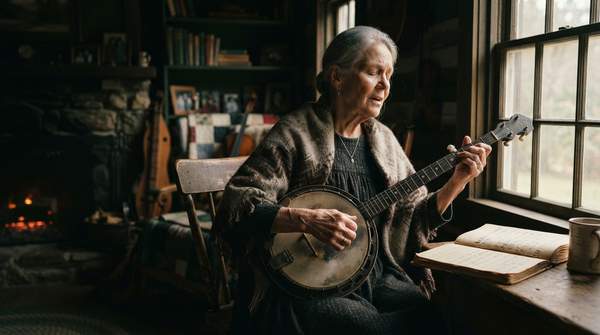
In the secluded mountains of Appalachia, a rich tapestry of stories was woven not in books, but in song. Traditional folk ballads, carried across the Atlantic and nurtured in the region's unique isolation, became the primary vehicle for preserving community history, cultural memory, and social values. These songs, passed down through generations by word of mouth, functioned as a living archive, chronicling everything from unrequited love and local tragedies to cautionary tales of murder. By blending diverse musical traditions, these story-songs forged a sound and a narrative tradition that was uniquely Appalachian.
Roots Across the Atlantic: Musical Origins
The foundations of Appalachian music were laid by migrants who brought their cultural traditions with them to the Eastern United States. The music is deeply derived from the folk traditions of the British Isles, particularly the ballads, hymns, and fiddle music of England and Scotland. According to a paper from Eastern Kentucky University, many of these folk songs were passed down through aural transmission for generations before making their way to Appalachia with settlers. This European heritage remains audible in the songs' content, with lyrics that, as the Music Maker Foundation points out, reference castles, lords, and ladies, often surprising audiences listening in a region geographically and culturally distant from those roots.
However, this tradition did not develop in a vacuum. In the New World, it mingled with the music of other ethnic groups, most significantly those of African origin. African musical traditions had a profound impact on the region's sound, influencing all styles of Appalachian music. The banjo, an instrument with African origins, became a staple, and the blues provided a foundational element for later genres like bluegrass and country music that grew from these traditional roots. This blending of European melodic and narrative structures with African rhythmic and instrumental contributions created a new, distinctly American musical form.
Oral Tradition and Geographic Isolation: Preserving the Lore
The remarkable survival of these ancient songs in the Southern Appalachians owes much to two key factors: the method of their transmission and the region's geography. The ballad tradition was primarily an oral one, with songs and stories passed from one generation to the next through listening and repetition. This aural transmission was the essential mechanism for cultural continuity in communities where literacy was not widespread, turning memory and performance into a form of living history.
The mountainous terrain itself played a crucial role in this preservation. A paper from Duke University's Graduate Liberal Studies program notes that the Southern Appalachian mountains proved to be "fertile ground for the preservation" of these story-songs. This geographic isolation shielded the tradition from the homogenizing effects of outside cultural and commercial influences, allowing it to flourish and develop on its own terms. Within this environment, specific families became crucial custodians of the music.
According to research from Bass Connections at Duke, old Appalachian families, such as the Hicks family of Beech Mountain, North Carolina, who have English roots dating to the late 18th century, were largely responsible for the preservation and transmission of these unique cultural expressions. Some singers in the region belong to the eighth generation of performers in their families, embodying a direct, unbroken link to centuries of storytelling.