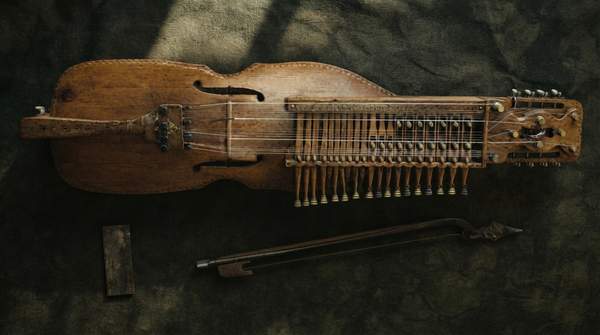
Three folk string instruments carry the musical identity of three European regions: the Swedish nyckelharpa, bowed and played through wooden keys; the Norwegian Hardanger fiddle, a violin fitted with sympathetic strings that ring beneath the melody; and the Greek bouzouki, a long-necked lute strung in pairs. Each belongs to a familiar instrument family, yet each departs from the standard design in one decisive way—and that single mechanical change defines its sound and its cultural role. Understanding these three adaptations is the fastest way to tell the instruments apart, whether heard in a recording or seen in a player's hands.
The Swedish Nyckelharpa: Keys to Resonant Sound
At first glance the nyckelharpa looks like a hybrid of a violin, a keyboard, and something out of a Viking legend; its Swedish name literally means "keyed harp" or "keyed fiddle." Unlike the violin, where pitch changes by pressing strings directly onto the fingerboard, tones on the nyckelharpa change by depressing wooden keys built into the instrument's neck. Attached to each key is a small wooden tooth called a tangent: press the key and the tangent presses against the string, producing a stop. Violinists use their fingers to stop notes; nyckelharpa players use keys and tangents instead.
Its cultural roots run deep in Sweden. Smithsonian Folkways notes that evidence suggests the first nyckelharpas may have arrived from Germany as early as the 14th century, and that these were quickly absorbed into the world of the spelmen, the fiddlers who play a central role in the social life of traditional Swedish communities.