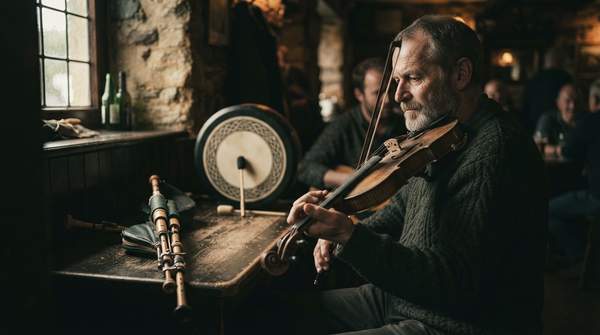
At the core of traditional Irish music lies a trio of instruments whose distinct voices weave together to tell the story of a nation: the fiddle, the bodhrán, and the uilleann pipes. More than mere tools for performance, these instruments are the custodians of a cultural legacy, shaping the sound of celebration, sorrow, and resilience. Their evolution reflects the social history of Ireland itself, from intimate gatherings in rural homes to the lively pub sessions that are now a global symbol of Irish identity. Together, they form the melodic, rhythmic, and emotional heart of a musical tradition passed down for centuries.
The Fiddle: Melody and Regional Identity
The fiddle is a primary melodic instrument in Irish traditional music, its voice carrying the tunes that form the backbone of the repertoire. While structurally similar to a classical violin, the fiddle is defined by its playing style, which is deeply rooted in regional identity. The way a musician plays can reveal their origins; according to professional musicians with the Traditional Irish Music Pub Crawl, an experienced listener can identify a player's home county within just a few bars of music. This regional variation is a hallmark of the tradition.
For example, the fiddle style of Donegal is known for its driving, rhythmic energy, while the music from County Clare is characterized by a smoother, more flowing quality. These are not subtle distinctions but rather distinct musical dialects that evolved through oral transmission within local communities. The fiddle adds a sense of sparkle and movement to the music, setting the tone for dance styles like jigs and reels and serving as a central element in the lively, social experience of an Irish session.
The Bodhrán: Rhythmic Pulse of Gatherings
While percussion is not always a dominant feature in Irish traditional music, the bodhrán is the instrument most commonly used to provide its rhythmic foundation. This frame drum, typically made with a goatskin head, is played with one hand while the other is placed against the inside of the skin to control the pitch and timbre. Its primary role is to drive the rhythm forward, providing a steady pulse that is essential for both dancers and other musicians.
The bodhrán's journey into the mainstream of traditional music is a story of adaptation. It evolved from a simple agricultural tool into a nuanced percussion instrument capable of sophisticated techniques. In a musical gathering, or session, the bodhrán creates a lively and social atmosphere, underpinning the melodic instruments and shaping the core sound of the ensemble. Its deep, resonant beat is often described as the heartbeat of the music, a vital component of the shared experience.