Gagaku is Japan's oldest traditional performing art — a repertoire of court music and dance that UNESCO describes as "characterized by long, slow songs and dance-like movements" and "the oldest of the Japanese traditional performing arts." Its name literally translates as "elegant music," and it is performed today at banquets and ceremonies in the Imperial Palace as well as in theatres across Japan. What makes Gagaku remarkable is not just its antiquity but its survival: a fusion of native Japanese song and continental Asian traditions, nearly lost during civil war, revived under the shoguns, and now protected as cultural heritage of universal value.
What is Gagaku? Japan's Ancient Court Music
When you hear Gagaku for the first time, you notice its pace. This is music that unfolds slowly, with long-held tones and dance-like movement, rather than driving rhythm or dramatic crescendo. UNESCO, which inscribed Gagaku on its Representative List of the Intangible Cultural Heritage of Humanity in 2009, notes that the art encompasses three distinct forms: ancient Japanese songs and dances, instrumental music from the Asian continent, and vocal music with dance.
The Imperial Household Agency, whose Music Department maintains the tradition, frames Gagaku as court music and dance passed down through the millennia. Its documented performance life dates from the tenth century in the Heian period onwards, when it served religious ceremonies and non-religious events of the imperial house and aristocracy. In other words, Gagaku was never popular entertainment in the modern sense; it was, and remains, ceremonial music — an art form whose very purpose is tied to occasion, place, and continuity.
A Journey Through Time: The Evolution of Gagaku
Gagaku's story is one of layering. According to the Pacific Asia Museum at USC, this centuries-old legacy comprises many musical traditions and influences, both domestic and those that traveled along the Silk Road. Among the most distinct are native songs and dances such as kagura and yamato-mai, and foreign traditions from continental Asia: tōgaku, music of Chinese origin, and komagaku, music of Korean origin. A Stanford University Gagaku resource confirms this structure, describing how the term covers indigenous accompanied vocal music alongside kangen (instrumental music) and bugaku (music with dance) derived from the Asian mainland, subdivided by region of origin into those same Chinese and Korean streams.
The tradition then faced its greatest crisis. During the Muromachi period (1336–1573), fierce civil wars brought Gagaku almost to the point of discontinuation. Its rescue came under the Tokugawa shogunate: during the Edo period (1603–1868), the shogunate reorganized the repertoire, and the Pacific Asia Museum notes that this revived form was close to what is played today. That reorganization proved decisive, because the musicians of the imperial court have transmitted it ever since.
Modern recognition followed in two steps. In 1955, Gagaku as performed by the court musicians of the Imperial Household Agency's Music Department was designated an Important Intangible Cultural Property, with the musicians collectively named holders of that designation — what is commonly called "living national treasures." Then, in 2009, Gagaku was inscribed on UNESCO's Representative List, recognizing it internationally as Japanese traditional culture that should be transmitted across generations.
The Gagaku Orchestra: An Explanatory Model
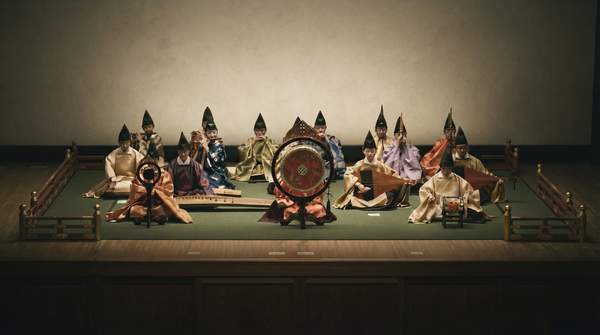
To understand how Gagaku produces its characteristic sound, I find it helps to model the orchestra as three functional layers. The Pacific Asia Museum identifies three instrument groups — percussion, strings, and winds — and describes how they interact: percussion generates rhythms layered under the winds' melodies, while strings add both melodic and rhythmic elements. The table below classifies the key instruments named across the evidence and synthesizes their roles, so you can hear the ensemble in your mind as a stack of distinct contributions rather than a single undifferentiated drone.
| Instrument Group | Key Instruments | Musical Role in the Ensemble |
|---|---|---|
| Winds | Hichiriki (a double-reed instrument, often compared to an oboe), shō (mouth organ), ryūteki, kagurabue, komabue | Carry the melodies; the hichiriki's piercing tone and the shō's sustained chords define the melodic and harmonic surface above the ensemble. |
| Strings | Koto (a plucked zither, often described as a Japanese harp), biwa (plucked lute), wagon | Add both melodic and rhythmic elements, punctuating and coloring the winds' lines with plucked articulation. |
| Percussion | Taiko (drum), shōko (bronze gong), kakko, san-no-tsuzumi, shakūbyōshi | Generate the rhythms layered beneath the winds, marking time and ceremonial structure for the whole ensemble. |
Notice how the model works in performance: the winds — hichiriki and shō foremost — supply the melodic and harmonic layer you notice first; the strings weave melodic and rhythmic detail through it; and the percussion, including the deep taiko and the ringing shōko gong, grounds everything with a slow, deliberate pulse. The instrumentation also reflects Gagaku's history: the wagon and kagurabue belong to the indigenous vocal repertoire, while instruments like the komabue appear in the Korean-derived komagaku tradition, so the orchestra itself embodies the meeting of native and continental streams.
Enduring Legacy: Gagaku in Imperial Court and Shinto Rituals
Gagaku endures because it was never merely an art form — it was an institution. The Pacific Asia Museum notes that it has been passed down "with great pride and care for centuries under the patronage of the imperial family," and that it is performed on religious and ceremonial occasions, which places it squarely within Shinto ritual life as well as court ceremony. The Imperial Household Agency's Music Department remains the tradition's custodian, and its musicians' activities continue today specifically to preserve the format of Gagaku as it has been transmitted across the millennia.
The tradition is also not frozen in the past. The court musicians are proficient in Western music and perform at Imperial Palace events; the Music Department is, in fact, one of Japan's oldest performing bodies of Western music. Gagaku has also traveled abroad — in 2018, performances were given in Paris and Strasbourg to mark the 160th anniversary of Japan-France diplomatic relations. The 1955 and 2009 designations, domestic and international respectively, formalized what the imperial court had long practiced: this music is treated as heritage with, in the Imperial Household Agency's words, "universal value in terms of both history and art."
Preserving a Living Tradition
To appreciate Gagaku, focus on its historical resilience and the distinct roles of its instrument families, recognizing it as a continuous cultural heritage rather than a museum piece. The decision worth making as a listener is to hear the music structurally: identify the winds' melody, the strings' interlacing figures, and the percussion's slow foundation, and you will hear a thousand-year conversation between native Japanese song and continental Asian traditions. The measurable indicator of the tradition's health is concrete: the continued public performances and official designations maintained by institutions like the Imperial Household Agency and UNESCO — from the 1955 living-national-treasure designation to the 2009 UNESCO inscription and performances continuing today — which together show that this elegant music is still being transmitted, not merely remembered.