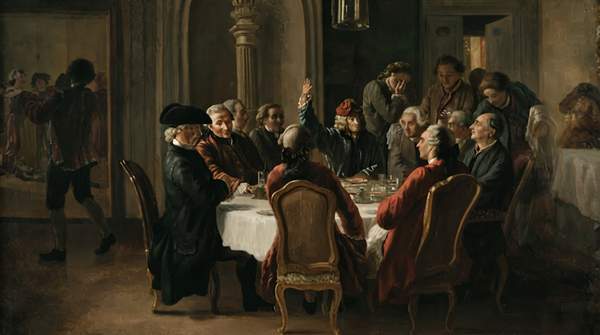
A literary salon was a regular private gathering, usually hosted in a woman's home, where writers, artists, thinkers, and aristocrats met to converse, listen, and learn from one another. Its defining feature, as one historical account puts it, was that "the focus was on listening and speaking to each other, learning from those around you, your fellow guests at the salon." Yet modern scholarship argues we misread these gatherings if we treat them as purely intellectual forums: they were, above all, institutions of elite leisure whose social structure made them a powerful vehicle for Enlightenment thought.
Beyond Book Clubs: Defining the Literary Salon
The word salon comes from the Italian sala or salone, meaning a reception hall or living room, and the name stuck because these gatherings were literally held in such rooms. Annika Barranti Klein, writing for Book Riot, describes the salon as "a place for people to exchange ideas," frequented often, though not always, by creative types. The first recorded salons took place in Italy in the fifteenth century, drawing artists, poets, musicians, and thinkers together across social classes, out of the scrutiny of the Roman Catholic Church. These Italian gatherings became popular during the Renaissance and flourished during the French Enlightenment, and the French tradition became the most famous and influential form.
What separated the salon from a modern book club or lecture was its privacy. Compared with formal court levees, the private nature of salons allowed ideas to be shared without fear of the government, including ideas critical of that government. The salon was thus a domestic, semi-protected space where conversation itself was the event.
The Salon as Elite Leisure: A Foundation for Intellect
The most important scholarly correction to the popular image comes from Dena Goodman's research, which inspired historians to reevaluate the salons' historical importance and to study seriously the women who received writers in their homes. A Stanford Humanities Center analysis building on that reevaluation argues that thinking of salons as outposts of the "Republic of Letters" is misguided, because it "induces us to consider salons as literary or intellectual venues, whereas they were, above all, the social spaces of elite leisure."
This reframing matters. Treating salons as intellectual projects produces odd consequences, the same analysis notes: it would imply that eighteenth-century salons had nothing to do with their predecessors under Louis XIII and Louis XIV or their nineteenth-century successors, and that the women who hosted were motivated solely by a desire to contribute to an intellectual endeavor. It is far more effective, the argument runs, to think of salons as the main institution of cultural sociability for social elites, and then to ask why the philosophes spent so much time there. The leisure came first; the intellectual ferment was its product.