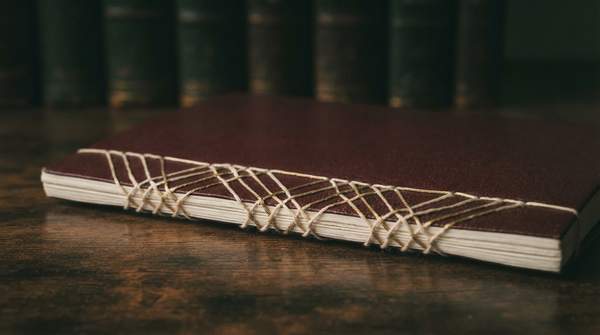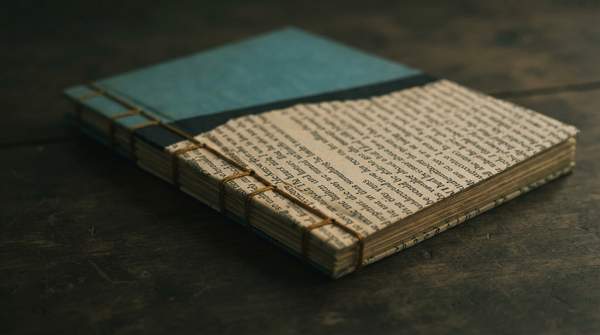
Traditional Ethiopian bookbinding is a chain-stitch craft that looks, at a glance, like the better-known Coptic binding—but the resemblance conceals a defining mechanical difference. Where a Coptic book is sewn with a single continuous thread, an Ethiopian book uses an independent thread and needle for each pair of sewing stations. That structural choice, combined with parchment leaves and wooden board covers, produced books robust enough to carry Ethiopia's manuscript heritage across centuries.
Introduction to Ethiopian Bookbinding: A Distinct Tradition
The technique, known in its homeland as medegos, is documented from sixteenth-century Ethiopia, with a surviving Ethiopian gospel book bound at the Gunda Gunde Monastery in the first half of that century standing as an early exemplar. It belongs to the same family as the multi-section Coptic method: quires are sewn with an unsupported chain stitch, leaving a chain-like pattern of threads exposed along the spine, and the book opens flat because nothing restrains the spine.
Yet the two traditions are not interchangeable. A comparative study of Ethiopian and Coptic sewing techniques argues the two are distinct enough that the common label "Coptic chain-stitch" misleads, and that Ethiopian manuscripts predating the thirteenth century are scarce for historical reasons—meaning our picture of the craft rests largely on later surviving books. What those survivors show is a tradition that changed little over time: one craft historian observes that Ethiopian book structures remained closer to early Coptic forms than the Coptic style itself, which continued to evolve.
Core Materials and Structural Elements
A traditionally bound Ethiopian book is a sandwich of simple, durable parts. The text block consists of folded parchment leaves gathered into quires—a single book could contain more than twenty-five of them. These sit between two wooden covers, and the whole assembly is sewn together through holes made in the edges of the boards. Most books were left uncovered and finished without endbands, leaving the construction plainly visible.
The sewing holes were made in the parchment in a straight line with a needle before the text was even copied, so the binding plan preceded the writing. The thread itself was nothing exotic: examination of extant books shows linen, cotton, and catgut all in use. The wooden boards show honest, unrefined workmanship—they are described as not square, unbeveled, and bearing visible tool marks. For larger books, two or more boards were sewn together end-to-end, presumably because boards of the required size could not be made from a single piece of wood.
The Multi-Needle Chain Stitch: How Quires are Connected
The heart of the technique is the sewing. Like Coptic binding, the Ethiopian method uses an unsupported chain stitch to connect quire to quire, which is what produces the chain-like pattern of threads along the spine and allows the book to lie open without resistance. But the Ethiopian method is distinguished by its thread economy: each pair of sewing stations gets its own independent thread. Two holes mean two needles; four holes mean four needles.
Paired sewing stations—up to seven pairs for larger books—were employed, with two needles used for the link stitch at each pair. The consequence is structural as much as aesthetic. Because no single thread runs the length of the book, each station's link is a separate, self-contained connection between adjacent quires. The chain you see on an Ethiopian spine is therefore a series of independent links rather than the visible course of one continuous thread.
Visualizing the Ethiopian Chain Stitch: A Multi-Thread System
To see how the Ethiopian stitch works, it helps to trace each thread separately through a simplified two-station binding. The model below deconstructs the sewing into discrete stages, mapping each independent thread's path so the difference from a single-thread Coptic stitch becomes visible. The stages follow the construction sequence the surviving evidence describes: holes prepared in advance, quires folded, then sewing through the board edges and gatherings.
| Stitching Stage | Thread Path (Needle 1) | Thread Path (Needle 2) | Resulting Link Between Quires |
|---|---|---|---|
| Preparing the first quire | Enters at the first pre-made hole and secures itself to the board through the hole in the board's edge | Enters at the second pre-made hole and secures itself to the board independently | First quire is fastened to the cover at two separate stations, with no thread shared between them |
| Attaching the second quire | Passes into the corresponding hole of the second quire and loops around the stitch below, forming a link | Passes into its own corresponding hole and loops around its own stitch below, forming a separate link | Two independent chain links appear on the spine, one per station |
| Continuing the chain | Repeats its loop at each new quire, always at station one | Repeats its loop at each new quire, always at station two | Each station's chain grows independently; neither thread ever crosses to the other station |
| Comparison with Coptic sewing | A Coptic sewer would typically carry one continuous thread from station to station and quire to quire | The Ethiopian spine shows discrete, station-bound links rather than the course of a single traveling thread | |
The comparison row is the crux: in a Coptic binding, one thread's journey connects everything, so a break anywhere threatens the whole sewing. In the Ethiopian system, each pair of stations is a separate connection, and the number of needles scales with the number of holes. This is the primary structural difference between the two methods, and it is what a careful look at the spine reveals.
Ethiopian vs. Coptic Binding: Clarifying the Distinction
Because the two share so much—an unsupported spine, exposed chain stitching, wooden covers, a book that lies flat—the confusion between them is understandable. The comparative literature on the two techniques works specifically to correct it, rejecting "Coptic chain-stitch" as a blanket term and locating the distinction in the thread mechanics: independent threads on multiple sewing stations in Ethiopia, a single-thread approach in Coptic binding.
The distinction matters practically for anyone identifying a binding. The chain pattern alone will not settle the question, since both traditions produce one. What settles it is the thread logic behind the pattern: whether the links along the spine belong to separate, station-bound threads or to one continuous course. The materials offer supporting clues—Ethiopian boards with their visible tool marks, and parchment quires sewn through pre-punched holes, point to the Ethiopian tradition even before the sewing is examined.
Enduring Legacy: Preservation of Ancient Manuscripts
The craft's significance lies in what it carried. Ethiopia's manuscript heritage—gospel books and other texts bound in this style—survived in part because the construction was built to last: parchment leaves, wooden boards, and a chain stitch that holds quire to quire through holes reinforced in advance. The longevity belongs to the materials and construction together, not to the stitch alone.
That the structure stayed so close to early Coptic forms, while the Coptic style itself evolved, suggests a deliberately conservative craft—one in which the binding method itself became a tradition worth preserving. The surviving books, from the Gunda Gunde gospel onward, are the record of that conservatism, and the scarcity of earlier Ethiopian manuscripts means these later survivors carry a disproportionate share of what we know.
Recognizing the Craft: What to Look For in Ethiopian Bindings
To identify a traditional Ethiopian binding, focus on the visible chain stitch along the spine, the presence of wooden board covers, and the distinct appearance of independent thread links between quires, which differentiates it from a continuous Coptic stitch. The measurable indicator is the visual pattern of the chain stitch and the material composition of the covers and text block: parchment quires between wooden boards, sewn through pre-made holes, with links that belong to separate station-bound threads rather than one traveling thread. A binding that meets that description is Ethiopian in the traditional sense; a chain-stitched book whose spine shows a single thread's course is something else.
Sources
- Ethiopian binding - Wikipedia — EN
- Academia
- Bound Together: Coptic, Ethiopian, Byzantine — Yet Another Sauce
- The History of Coptic Stitch Bookbinding — SQUUSHED