Oribe Glaze: Bold Green and Expressive Design
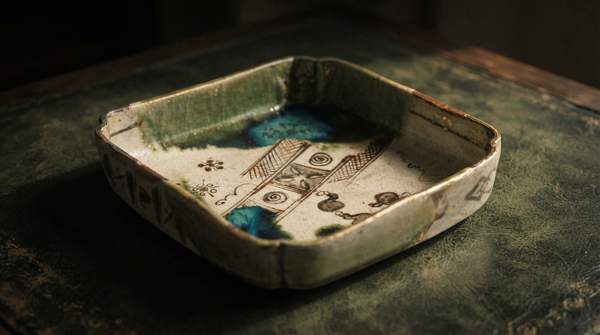
Oribe glaze is renowned for its bold, deep green color and expressive designs, which often incorporate geometric or natural motifs, according to Imoto Sangyo Ltd. This distinctive hue is achieved through the use of a copper glaze. Originating in the Mino area of central Japan in the late 16th century, Oribe ware was inspired by the influential tea master Furuta Oribe, as Micaela Schoop notes.
The rise of Oribe glaze was closely tied to the development of new firing techniques and the introduction of multi-chambered *noborigama* kilns. These kilns allowed Japanese craftsmen to achieve higher firing temperatures, around 1220°C, which facilitated the creation of new translucent glazes, explains Micaela Schoop. As *noborigama* kilns replaced the older *anagama* kilns in the early 17th century, Oribe glazes, better suited to the new technology, supplanted Shino ware, according to Zentner Collection and Wikipedia contributors. Oribe pottery often features purposefully distorted shapes and an intentional avoidance of symmetry, giving these ceramics from the late 16th to early 17th century a remarkably modern appearance, Micaela Schoop observes. The development of Oribe ware, alongside Shino and Kiseto, in the Mino region during the Momoyama period, exemplified a free and creative expression that became representative of Japanese tea ceramics, as noted by MUSUBI KILN.
Kiseto Glaze: Subtle Yellows and Earthy Tones
Kiseto glaze typically presents a yellowish-brown color, often accented with green spots and burnt scorch marks, according to Imoto Sangyo Ltd. This glaze is characterized by its subtle yellow tones and an elegant transparency. The specific hue and markings of Kiseto glaze are influenced by its iron content and the particular conditions of its firing. These elements collectively contribute to its rustic and natural aesthetic, making each piece uniquely reflective of its creation process.
Kiseto ware, like Shino and Oribe, was notably produced in the Mino region during the Momoyama period, a time when the aesthetics of Japanese ceramics underwent a significant shift due to the spread of the tea ceremony, as MUSUBI KILN explains. The subtle variations in color intensity, the flow and pooling of the glaze, and the subtle irregularities that emerge from handcrafting are all integral to the artistic value of Kiseto, as with other traditional glazes, according to Imoto Sangyo Ltd.
The Philosophy and Craft Behind the Glazes
The profound cultural significance of Japanese glazes like Oribe, Shino, and Kiseto extends beyond their visual appeal, embodying a deep connection to nature, aesthetics, and history, as Imoto Sangyo Ltd. highlights. The unique characteristics of these glazes—such as variations in color intensity, the flow and pooling of the glaze, and the subtle irregularities from handcrafting—are increasingly recognized globally as hallmarks of authenticity and artistic value.
A critical factor in the distinctiveness of these glazes is the firing process itself. Traditional kilns, such as the *anagama*, allow fire and falling ash to leave markings that no potter can fully control, resulting in surfaces that are always unique, explains TOKI. In contrast, electric or gas kilns offer more predictability, making them suitable for mass production. This means that the same glaze can appear dramatically different depending on the kiln chosen, underscoring the role of the kiln environment in shaping the final aesthetic. The transition from *anagama* to multi-chambered *noborigama* kilns in the early 17th century was a pivotal moment, influencing the decline of Shino and the rise of Oribe, as the new kilns facilitated higher firing temperatures and new translucent glazes, according to Micaela Schoop and Zentner Collection.
The late 16th century Momoyama period marked a significant shift in Japanese ceramic aesthetics, driven by the widespread practice of the tea ceremony. Tea masters, including Sen no Rikyu, sought tea wares that possessed a rustic, powerful beauty, a departure from the ornate Chinese vessels that had previously been favored, according to MUSUBI KILN. During this era, the Mino region, in present-day Gifu Prefecture, became a hub for notable wares, including Kiseto, Shino, and Oribe. The soft white of Shino and the bold green glaze of Oribe became emblematic of free and creative expression, representing the essence of Japanese tea ceramics.
Even the *kodai*, or foot of a vessel, is considered a key aesthetic element in Japanese ceramics. Far from being purely functional, it reveals the potter’s style and is often left unglazed to prevent sticking during firing. During the tea ceremony, one is often asked to appreciate the *kodai* as a beautiful detail into which much thought has been put, TOKI explains. This attention to detail, combined with the dramatic carbon trapping in Shino or the organic imperfections that embody the *wabi-sabi* philosophy, offers endless opportunities for contemplation and appreciation, according to Zentner Collection.
These traditional glazes are more than mere decorative coatings; they embody a profound cultural narrative. Their unique characteristics, influenced by material composition, firing techniques, and philosophical concepts, offer a deep appreciation for the artistry and history embedded in Japanese ceramics.