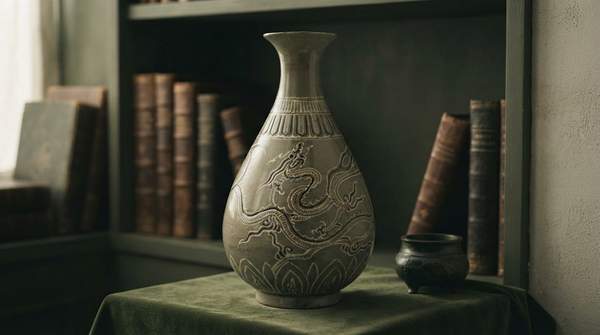
The quickest way to distinguish Goryeo celadon from Joseon buncheong is to look at the surface. Celadon, the green-glazed stoneware that flourished under the Goryeo dynasty (918–1392), carries a smooth, pale green, jade-like glaze over the whole body. Buncheong, which emerged in the following Joseon dynasty (1392–1897), is a grey stoneware coated in white slip—a liquid white clay layer that becomes the canvas for freer, more spontaneous decoration. The two traditions are historically sequential, and understanding how one gave way to the other reveals a broader shift in Korean artistic sensibility.
Introduction to Korean Pottery Traditions
Korean pottery developed a distinct style of its own, with characteristic shapes and techniques that set it apart from its Chinese origins. Celadon itself was first produced in China and reached the Korean peninsula through increased contact with the Song Dynasty, with production in Korea beginning in the twelfth century, as the Korean Culture and Information Service's account by journalist Yoo Juhyun relates. What Koreans did with the imported tradition, however, became something recognizably their own. The Art Institute of Chicago, in an essay by Yeonsoo Chee, describes how greenish celadon stoneware "rose to international prominence across East Asia during the Goryeo dynasty," while in the subsequent Joseon dynasty a greyish stoneware with white slip decorations—later known as buncheong ware—redefined ceramic production in Korea.
Goryeo Celadon: The Pinnacle of Refinement
Celadon of the Goryeo period is regarded by historians of the craft as some of the finest and most elegant pottery produced anywhere. Its defining feature is a pale green lustre reminiscent of jade, achieved through a super smooth glaze fired in an oxygen-reducing kiln; the glaze contains a low percentage of iron oxide, which produces the characteristic green. The association with precious jade may itself have contributed to celadon's prestige.
Its decorative pinnacle was the sanggam, or inlay, technique: patterns were etched into the clay and filled with differently colored clays before glazing. Common motifs included key-fret bands, foliate designs, and stylized fish. A famous contemporary verdict on the ware's refinement survives from a Chinese Song Dynasty courtier dispatched to the Korean kingdom, who wrote that "earthenware tinted in jade, dubbed 'celadon' by the Goryeo people, evolved [from the coloration we use] into a more delicate, wholesome hue," and called a Goryeo celadon incense burner "the most intricately created object I've seen."
Joseon Buncheong: Spontaneity and Adaptation
Buncheong ware occupies an intermediate position in Korean ceramic history. Wikipedia's overview of Korean pottery characterizes it as a form between earthenware and porcelain, one that adapted the white clay inlay tradition inherited from Goryeo celadon. Visually, the starting point is different: rather than a colored glaze unifying the vessel, buncheong consists of grey-colored stoneware coated in white slip, and that slip layer is the primary surface for decoration.
Where celadon's inlay work demanded meticulous carving and filling before the glaze ever touched the pot, buncheong's slip invited quicker, more gestural handling—brushing, incising, and manipulating the white coating directly. The result is a ware that reads as looser and more immediate than the aristocratic polish of Goryeo celadon, even though its technical ancestry runs directly back to the earlier inlay tradition. A surviving late-fifteenth-century flask with fish motifs, cited by the Art Institute of Chicago as an example of buncheong, shows the tradition in its mature Joseon form.
From Celadon to Buncheong: A Historical and Artistic Evolution
The transition from celadon to buncheong tracks the dynastic change itself: Goryeo fell in 1392, and the Joseon dynasty that followed produced the new grey-bodied, slip-decorated ware. The stylistic shift is well documented—museum collections even preserve vessels described as reflecting a transitional morph from celadon to buncheong ware, suggesting the change was gradual rather than abrupt.
Why the aesthetic changed is a matter of synthesis rather than direct record. The Korean Culture and Information Service's account notes that early Goryeo ceramics were shaped by aristocratic and Buddhist influences from China, and that an authentically Goryeo celadon style reached its prime only after the dynasty set up a military regime, stirred by a spirit of independence from foreign influence. If celadon's refinement expressed an aristocratic, internationally minded court, buncheong's spontaneity fits the more pragmatic sensibility of the early Joseon period—but that connection between political change and artistic style is an interpretation drawn from the historical context, not a claim any single source states outright.
Comparing Goryeo Celadon and Joseon Buncheong
The table below juxtaposes the two traditions across consistent criteria—era, aesthetic, surface treatment, and decoration—so that an observed piece can be matched against its most likely tradition. Read down each column to see the identity of each ware; read across each row to see the evolution between them.
| Dimension | Goryeo Celadon | Joseon Buncheong |
|---|---|---|
| Historical period | Goryeo dynasty (918–1392); production in Korea from the 12th century | Joseon dynasty (1392–1897); mature examples from the 15th century |
| Primary aesthetic | Refined greenish stoneware with iridescent hues and delicate decoration; a pale green, jade-like lustre | Greyish stoneware with white slip decoration; a form between earthenware and porcelain |
| Glaze/surface | Smooth celadon glaze with low iron oxide, fired in an oxygen-reducing kiln to yield the green color | Grey body coated in white slip, which serves as the decorative surface |
| Key decorative techniques | Sanggam (inlay): etched patterns filled with colored clays; motifs include key-fret, foliate designs, and stylized fish | Adaptation of the white clay inlay tradition inherited from celadon, applied to the slip surface |
Two visual checks follow directly from this comparison. First, the ground color: a jade-green, glassy surface points toward Goryeo celadon, while a grey body showing beneath or through white slip points toward buncheong. Second, the decoration's logic: precise inlaid patterns set into the clay body belong to the celadon tradition, while decoration worked into a white slip coating belongs to buncheong.
Appreciating Distinct Artistic Traditions
Neither ware should be judged as the lesser sibling of the other. Goryeo celadon represents the pursuit of an ideal—delicate, wholesome color and intricate inlay that impressed even visiting Chinese courtiers—while buncheong demonstrates how a tradition can inherit a technique and loosen it into something more expressive. Together they mark two successive answers to the same question of what Korean ceramics should be. This comparison deliberately leaves aside Joseon white porcelain and everyday stoneware such as onggi, and it is not a guide to authenticating or valuing antiques; those require expertise beyond what visual characteristics alone can establish.
Identifying and Appreciating Korean Ceramic Heritage
Readers can confidently distinguish between Goryeo celadon and Joseon buncheong pottery by observing their historical period, primary aesthetic, glaze or surface treatment, and key decorative techniques. The measurable indicator of that skill is simple: the reader can articulate at least two distinct visual or historical differences between a given example of Goryeo celadon and Joseon buncheong ware—for instance, celadon's jade-green iron-oxide glaze versus buncheong's white slip over grey stoneware, or the dynastic boundary of 1392 that separates their periods of production.
Sources
- Story — KOREAN Culture
- Tradition as Inspiration: Contemporary Korean Ceramics — The Art Institute of Chicago
- Korean pottery and porcelain - Wikipedia — EN