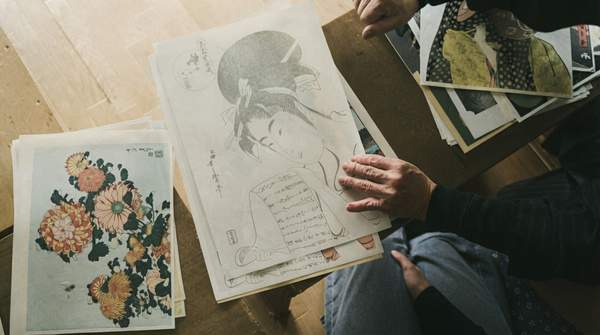
Ukiyo-e — the "pictures of the floating world" — was never the work of a single hand. Each image, the Library of Congress explains, "was created through the collaborative effort of four skilled individuals": a publisher who coordinated the specialized artisans and marketed the artworks, an artist who designed and drew the image in ink on paper, a carver who meticulously carved the designs into woodblocks, and a printer who applied pigments and printed each color on handmade paper. That division of labor is the key to understanding what ukiyo-e actually was: not a painter's solitary vision but a collaborative commercial product, produced in multiples for a broad public.
It was also a two-way cultural force. As an introduction to the genre from the Ronin Gallery puts it, while ukiyo-e was the product of Edo society, it equally shaped the development of that unique culture by promoting its humor, beauty, fashions, and heroes. The prints did not merely record the floating world; they helped decide what that world admired — and when that world began to crumble in the late Edo period, the same collaborative machine adapted to meet a changing one.
The Collaborative 'Quartet': Crafting an Ukiyo-e Print
The making of a single print began not with an image but with a business decision. The publisher initiated the project, commissioned the artist, coordinated the efforts of the specialized artisans, and carried the finished work to market. In this system the publisher was producer, manager, and distributor in one — the figure who judged a design sellable, assembled the team to realize it, and turned the resulting object into a circulating commodity. Nothing reached an audience without that judgment, and nothing returned as a new commission without a sale.
Only once the venture existed did the artist enter. The artist designed the artwork and drew it in ink on paper, producing the blueprint from which every later stage worked. This was the creative origin of the image, but only one origin among four contributors. The drawing, however fine, remained a drawing — ink on paper, singular and unpublishable at scale until the artisans who followed translated it into a reproducible form.
The carver performed that translation. Taking the artist's drawing, the carver meticulously carved the design into a woodblock — or, in most cases, a series of woodblocks, because each color demanded its own printing surface. The Library of Congress records the scale of that labor plainly: during the Edo period, the number of blocks per image averaged ten to sixteen. Every line of the design had to survive the knife, and the carved surfaces became the printing surfaces whose precision set the limits of what could be reproduced.
The printer closed the sequence. Applying pigments to the blocks and printing each color on handmade paper, the printer built the image layer by layer until the design was realized in full — one block, one color, one pass at a time, across an average of ten to sixteen surfaces. The final print was thus not a copy of the artist's drawing so much as a reconstruction of it, assembled through registration and careful pigment work that gave the object its colors and its physical form.
When the printing was complete, the circle closed. The Ronin Gallery notes that the publisher then distributed the finished work to eager audiences and commissioned new designs — feeding demand straight back into the start of the cycle. The genre's continuity, in other words, was commercial as much as artistic: one print's audience became the next print's commission.
The Collaborative 'Quartet' of Ukiyo-e Production
The framework below deconstructs that workflow into its four roles, ordered as each entered the process, so the division of labor from conception to distribution is visible at a glance.
| Artisan | Responsibility in the sequence | Contribution to the finished print |
|---|---|---|
| Publisher | Initiated the project, commissioned the artist, coordinated the specialized artisans, and marketed the artworks | Conceived the print as a commercial venture and delivered it to audiences; after printing, distributed it and commissioned new designs |
| Artist | Designed the artwork and drew it in ink on paper | Supplied the original image that every later step translated |
| Carver | Meticulously carved the design into a woodblock or a series of blocks — ten to sixteen on average per image in the Edo period | Created the printing surfaces whose precision determined the image's fidelity |
| Printer | Applied pigments to the blocks and printed each color on handmade paper | Gave the print its final colors and its physical form, layer by layer |
Read as a relay, the sequence runs: conception by the publisher, design by the artist, translation into relief by the carver, realization in color by the printer, and distribution by the publisher once more. The publisher's appearance at both ends is the tell. A print existed because someone judged it sellable, and it reached the public because someone carried it to market. Between those two moments stood three specialized skills, each essential to the object in hand.
The Library of Congress's claim of "nearly equal responsibilities" among the four is what gives this framework its diagnostic force. No artisan's brilliance could compensate for another's failure: a fine design carved carelessly, or printed without care, would not survive as a salable image. Recognizing the quartet therefore changes how a print should be read. The artist's name on a design marks the origin of the image, not the whole of its making — and crediting the artist alone names only one of the four hands that the object required.
A Mirror and Maker of Edo Society
The publisher's distribution role explains why ukiyo-e mattered far beyond aesthetics. Because prints circulated to a broad and eager audience, they carried Edo's values back to its own people. The Ronin Gallery's account makes the relationship explicitly reciprocal: the woodblock print became an unmistakable art form in the hands of Edo's artists, and while it was the product of Edo society, it equally shaped that society by promoting its humor, beauty, fashions, and heroes. The prints did not simply document a floating world; they circulated the things it laughed at, the beauty it admired, and the figures it celebrated.
The genre's responsiveness is clearest near its end. The floating world began to crumble in the late Edo period, yet the woodblock continued to evolve as a reactive medium. Yokohama-e — "Yokohama pictures" — recorded and circulated Japan's first impressions of the foreigners who poured into Yokohama in the 1850s. The same collaborative machine that had spread fashion and humor now processed a national encounter, turning unfamiliar arrivals into images for a mass audience.
That adaptation is the deeper significance of the quartet model. A genre built on commission and distribution could redirect its entire subject matter toward whatever its audience next needed to see — new fashions, new heroes, or new strangers arriving at a port. Its endurance through a transforming society owed less to any single masterpiece than to the flexibility of the industry that produced it. The Ronin Gallery's account of the era names one such master of the form in passing — Hokusai, whose woodblock print Mishima Pass in Kai Province dates to around 1833 — a reminder that even the most celebrated designs moved through the same four-stage process as any other print.
Recognizing Ukiyo-e's Enduring Legacy
The decision this history invites is to appreciate ukiyo-e not just as an art form, but as a product of a unique collaborative industry that profoundly shaped both Japanese culture and global art history. The quartet model is the practical lens for that appreciation: it distinguishes the commercial judgment that conceived a print from the drawing that designed it, the knife that rendered it printable, and the pigment work that realized it in color.
The measurable indicator to carry forward is this: observe how ukiyo-e's aesthetic principles continue to appear in modern art, design, and media, reflecting its lasting influence. A concrete way to begin sits inside the prints themselves. Recall that an Edo-period image averaged ten to sixteen carved blocks, each printed in its own color by hand on handmade paper. Count the colors in a surviving print and you count, roughly, the blocks carved for it — and with each counted layer, the scale of the four-person collaboration behind the object becomes visible again, one measured pass at a time.
Sources
- Overview - The Floating World of Ukiyo-e — LOC
- A Brief Introduction to Ukiyo-e — Roningallery