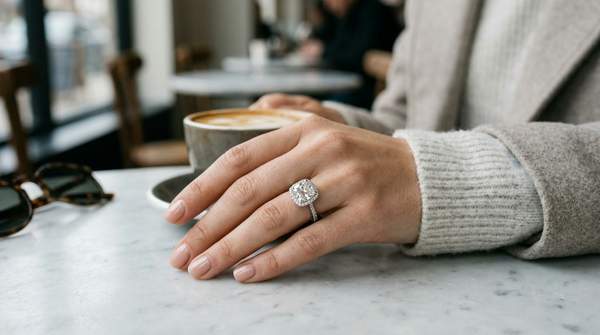
Place two cushion-cut diamonds beside each other. Both have softly rounded corners and nearly identical outlines, but one sparkles like a field of tiny ice crystals while the other produces broad flashes that sweep across its facets. Turn the stones slightly, and their differences become even more apparent.
Those two appearances are known as crushed ice and chunky faceting, and they can make cushion diamonds feel remarkably different despite sharing the same general shape. Ritani’s natural and lab-grown cushion-cut diamond collections offer both kinds of visual appeal, giving shoppers a reason to look beyond carat weight and discover the particular sparkle they want to wear.
A Cushion Diamond’s Shape Is Only the Beginning
Cushion diamonds have rounded corners and gently curved sides that resemble the outline of a pillow. Their proportions range from nearly square to noticeably elongated, offering different silhouettes within one familiar diamond category.
The greater surprise comes from the facets inside that outline. A cushion brilliant generally features larger, more defined reflections, while many cushion modified brilliants produce numerous smaller flashes.
Ritani distinguishes these appearances in its cushion-cut diamond collection and educational resources. The company offers individual stones with different proportions and cutting styles, allowing shoppers to compare diamonds that share an outer shape but have distinctly different internal patterns.
The difference is worth discovering early in an engagement-ring search. Someone drawn to the lively sparkle of a crushed-ice cushion may find a broad-facet stone less appealing, even when its carat weight, color, and clarity appear equally attractive.
Crushed Ice Has a Sparkle All Its Own
The crushed-ice effect comes from numerous small reflections scattered across the diamond’s interior. As the stone moves, those reflections appear and disappear, creating a lively, glittering surface that resembles tiny fragments of ice.
This appearance is commonly associated with cushion modified brilliant diamonds. Additional facet patterns, particularly on the pavilion beneath the stone’s upper surface, contribute to the smaller reflections that characterize the style.
The effect can be particularly striking in an elongated cushion. The diamond’s longer outline gives the glittering pattern more visible space, while the rounded corners preserve the softness associated with the cut.
A crushed-ice cushion can also make a beautiful solitaire. With the stone occupying the center of an otherwise restrained design, its intricate reflections provide much of the jewelry’s visual activity.
That combination appeals to someone who enjoys a glittering diamond without necessarily wanting a heavily decorated ring. A polished band and a cushion with fine, lively reflections can already create an expressive centerpiece.
Ritani’s cushion-cut selection includes diamonds in different lengths, widths, and carat weights. Once crushed ice becomes the preferred appearance, those choices provide another way to refine the finished look.
Chunky Facets Reveal the Diamond’s Internal Geometry
A traditional cushion brilliant offers a different spectacle. Its larger facets can create broad, defined flashes that reveal the internal pattern of the diamond as it moves.
The term “chunky” describes these prominent reflections. It refers to the appearance of the facet arrangement rather than suggesting that the diamond itself is unusually thick or bulky.
The style has a natural connection to antique-inspired jewelry because traditional cushion brilliants developed before modern modified brilliant variations. Their more recognizable internal geometry can give a contemporary diamond a visual character associated with older cutting traditions.
Look into a chunky-facet cushion, and the reflections may appear as distinct shapes rather than a field of fine glitter. A slight movement changes which facets appear bright and which show contrast, making the pattern engaging from different angles.
These broader flashes can be especially attractive in square cushions. The balanced outline provides a compact frame for the internal reflections, allowing the geometry to become one of the stone’s defining features.
A traditional cushion brilliant can also look striking in a modern engagement-ring setting. Clean metal lines around the stone give its facet pattern room to attract attention, creating a pleasing relationship between a simple exterior and a more intricate interior.
Hybrid Cushions Add Another Visual Possibility
Ritani also identifies hybrid cushion cuts that combine characteristics of traditional cushion brilliants and modified brilliants. These stones provide another option for someone drawn to more defined reflections.
In a hybrid cushion, the main pavilion facets can extend toward the girdle, producing a recognizable X-like arrangement beneath the table. The resulting reflections may appear more organized than the smaller flashes of a conventional crushed-ice cushion.
This distinction becomes especially interesting when examining grading reports. A hybrid can still be classified as a cushion modified brilliant by the Gemological Institute of America, because “hybrid” is a descriptive term rather than a separate formal cutting-style designation.
Ritani’s diamond education explains how the pavilion facet arrangement contributes to this appearance. On qualifying GIA grading reports, the facet diagram can provide additional information about how the diamond was cut.
The hybrid style offers a different visual experience from both strongly glittering crushed ice and traditional chunky faceting. Its appeal comes from the particular arrangement of larger reflections within the modified brilliant structure.
This is one reason individual stone imagery deserves attention. A cutting-style label offers valuable information, but the actual reflections reveal the character of the diamond someone will eventually wear.
Square or Elongated Changes the Whole Impression
Once the preferred facet appearance emerges, the cushion’s proportions introduce another design decision. A nearly square stone creates a balanced silhouette, while an elongated cushion produces a more directional shape.
Ritani carries both proportions in natural and lab-grown diamonds. Their differences become especially apparent when imagining the stone at the center of an engagement ring.
A square cushion with chunky facets can feel compact and architectural. Its orderly outline complements the broad reflections inside, creating a centerpiece with a strong sense of symmetry.
An elongated crushed-ice cushion creates another impression. The longer shape directs the eye along the finger, while its fine reflections introduce movement across the diamond’s surface.
The combinations can also be reversed. A square crushed-ice stone offers lively sparkle within a balanced outline, while an elongated cushion with broad facets brings more defined reflections into a longer silhouette.
Carat weight interacts with these proportions, but it does not determine them. Two cushions of similar weight can have noticeably different face-up measurements because their dimensions and depth vary.
Ritani’s individual diamond listings provide the measurements needed to distinguish those shapes. A comparison of length and width can therefore complement the visual impression created by the facets.
Let the Diamond Move Before You Decide
Photographs introduce the appearance of a diamond, but movement reveals more about its faceting. A reflection that looks broad in one position may change dramatically when the stone turns.
Ritani’s loose-diamond listings include individual specifications and available imagery, with rotating views or videos provided for selected stones. These features offer a way to compare how different cushion diamonds reflect light.
Begin with two stones that have reasonably similar proportions. This makes the differences in their internal patterns easier to recognize without the comparison being dominated by one stone’s larger dimensions.
In a crushed-ice cushion, notice how many small reflections appear across the surface. Their distribution creates the glittering texture that defines the style.
In a chunky-facet cushion, pay attention to the larger areas of brightness and contrast. The movement of those reflections can make the diamond’s internal geometry particularly recognizable.
Lighting contributes to the experience as well. Concentrated light may emphasize glittering flashes, while more diffuse conditions reveal another side of the diamond’s appearance.
The comparison can become surprisingly personal. One shopper may love the busy sparkle of crushed ice, while another repeatedly returns to the broader reflections of a cushion brilliant.
Ritani’s inventory gives those preferences a practical direction. The shopper can identify individual diamonds worth considering, rather than treating every cushion with an appealing grade as interchangeable.
Give the Diamond a Setting That Complements Its Sparkle
The setting introduces another layer of design once the diamond itself has been selected. Ritani offers cushion-compatible engagement-ring styles that include solitaires, halos, and diamond-accented bands.
A solitaire gives the center diamond considerable visual space. The cushion’s outline remains prominent, allowing either fine crushed-ice reflections or broader flashes to become the main attraction.
A halo adds smaller diamonds around the cushion, extending sparkle beyond its perimeter. The surrounding stones create a more decorative composition while the center retains its distinctive facet pattern.
A diamond-accented band provides another treatment. Reflections continue along the finger, creating a connection between the cushion centerpiece and the ring surrounding it.
Metal color changes the overall presentation as well. Yellow gold brings warmth around the stone, while white gold and platinum provide cooler surroundings.
These choices can be considered through Ritani’s engagement-ring selection, where compatible settings allow the chosen cushion diamond to become the focal point of the finished design.
Frequently Asked Questions
What is a crushed-ice cushion-cut diamond at Ritani?
A crushed-ice cushion diamond has numerous small reflections that create a glittering appearance. Ritani explains that this effect is commonly associated with cushion modified brilliant faceting.
What does chunky faceting mean in a cushion diamond?
Chunky faceting describes the larger, more defined reflections associated with traditional cushion brilliants. The stones can reveal broad flashes and recognizable internal patterns as they move.
Can a cushion modified brilliant have broader flashes?
Yes. Ritani also discusses hybrid cushion modified brilliants with extended pavilion facets that can produce more organized reflections, including an X-like pattern beneath the table.
Does Ritani offer both natural and lab-grown cushion-cut diamonds?
Yes. Ritani offers natural and lab-grown cushion diamonds in different proportions, carat weights, and individual cutting styles. Shoppers can compare available imagery and specifications before selecting a compatible engagement-ring setting.
Find the Cushion Diamond With Your Favorite Sparkle
Crushed ice brings fine, lively reflections, while chunky faceting produces broad flashes that reveal the diamond’s internal geometry. Ritani’s natural and lab-grown cushion selection offers both, along with different proportions and engagement-ring settings. Compare individual cushion-cut diamonds at Ritani and choose the stone whose sparkle keeps catching your eye.