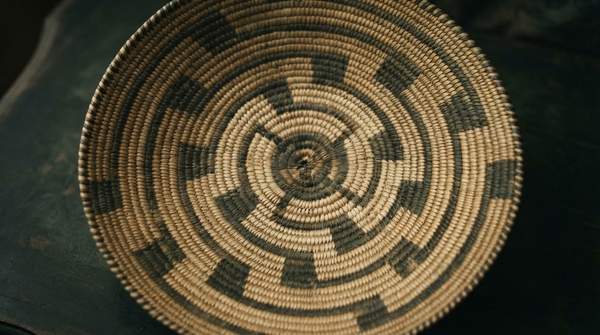
Almost every traditional basket in Native North America is built from one of three structural techniques: plaiting, twining, or coiling. As the SFO Museum's exhibition text on Native North American basketry explains, these are the three basic techniques commonly employed, with countless variations existing within each. Learning to tell them apart is the fastest way to connect a basket in your hands—or in a museum case—to the plants it was made from and the community that made it. This guide explains the mechanics of each weave, follows the Hodinohso:ni process of turning a black ash tree into weaving splints, and considers why the craft carries meaning well beyond its usefulness.
Foundational Weaving Techniques: Plaiting, Twining, and Coiling
Plaiting is the technique most people picture when they imagine Native American basket weaving, as Alderleaf Wilderness College's guide to native basketry puts it. Structurally, it is the simplest of the three: two elements are woven over and under each other at a right angle, producing the familiar checkerboard surface. Alderleaf describes the process as beginning at the base, weaving flat slats together in an over-under pattern so that each following slat goes over where the previous one went under, then folding the slats upward to form the sides. Baskets made this way can be beautiful but also rugged and sturdy, the guide notes, and they are often made of flat slats of material such as oak or ash splints, river cane, and cedar.
Twining works differently. Instead of a single weft passing over and under, two or more horizontal strands—the wefts—are wrapped and twisted between vertical strands, the warps. The twisting motion locks each pair of wefts around the warps as the work progresses upward, which gives twined baskets their characteristic diagonal texture and considerable structural strength. This wrapping-and-twisting action is what distinguishes twining from plaiting at a glance: a plaited surface shows a regular checkerboard of wide, flat elements, while a twined surface shows paired strands crossing around uprights.
Coiling abandons the warp-and-weft logic altogether. Rather than interlacing elements across each other, the maker sews plant fibers around a foundation material, and each new row is stitched onto the one below it. The basket grows as a spiral, row by row, in the manner of a coiled rope bound to itself. Because the form is built from sewn bundles rather than interlaced strands, coiling allows smooth, tightly controlled curves and walls—qualities that the other two techniques achieve with more difficulty. The SFO Museum's exhibition text emphasizes that these three categories are starting points rather than rigid boxes: countless variations exist within the three techniques, and individual traditions blend and adapt them.
Recognizing which technique a basket uses is therefore the first diagnostic step. Ask where the structure comes from: if it comes from flat elements crossing at right angles, it is plaiting; if it comes from paired strands twisted around uprights, it is twining; if it comes from rows sewn onto the rows beneath, it is coiling.