Traditional woodworking joints are fundamental to the art and engineering of fine furniture, offering distinct structural advantages, aesthetic qualities, and historical significance. These time-honored techniques, which prioritize the natural strength and movement of wood, are crucial for creating durable, legacy pieces that can last for centuries. Understanding the unique characteristics of joints like the dovetail, mortise and tenon, and lapped joint allows for informed decisions in furniture appreciation, selection, and restoration.
The Dovetail Joint: Strength, Beauty, and Heritage
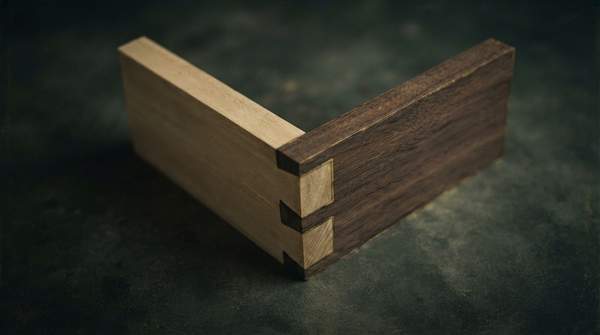
The dovetail joint is renowned for its exceptional tensile strength, making it particularly effective in resisting pulling forces. This interlocking design, characterized by trapezoidal "tails" on one piece fitting into corresponding "pins" on another, provides superior anti-deformation capacity, especially in box frames and cabinet structures, according to research published in BioResources. Its resistance to tensile forces increases with the angle and precision of the matching components, and it also exhibits flexural behavior with moment resistance, as detailed in a study on timber dovetail mortise-tenon joints from Edinburgh Research Explorer.
Aesthetically, the exposed pattern of interlocking tails and pins is often celebrated as a hallmark of quality and craftsmanship. Hand-cut dovetails, with their subtle irregularities in pin and tail spacing, visibly attest to the artisan's skill, as noted by Boston Mills. This decorative quality is frequently highlighted in fine furniture, particularly when crafted from woods like oak, ash, or walnut, which are historically popular choices for their strength and durability, according to a paper on the historical application of dovetail corner joints. Historically, dovetail joints have been a staple in the construction of drawers, boxes, and cabinets, symbolizing high-quality craftsmanship.
The Mortise and Tenon Joint: Robustness in Frame Construction
The mortise and tenon joint is a cornerstone of frame construction, providing robust resistance to racking and shear forces. This joint involves a projecting tenon on one piece of wood fitting snugly into a rectangular mortise cavity in another, creating substantial glue surface area and mechanical resistance to separation, as explained by Boston Mills. Blind mortise-and-tenon joints are commonly employed in furniture, such as chairs, to connect critical structural members like side rails to posts and stretchers to posts. These joints are designed to resist external loads through internal reactive bending moments, shear forces, and axial tensile forces, according to research published in the journal Wood and Fiber Science.
From an aesthetic perspective, the mortise and tenon joint offers significant versatility. It can be designed to be either visible, showcasing the craftsmanship, or completely concealed for a clean, minimalist appearance, as noted by Frailey Woodworks. This adaptability allows it to serve both decorative and purely structural purposes within a design. Historically, the mortise and tenon joint has been a foundational element in furniture and timber frame construction for centuries, used extensively in tables, chairs, and doors, contributing to the longevity of pieces found in museum collections worldwide.