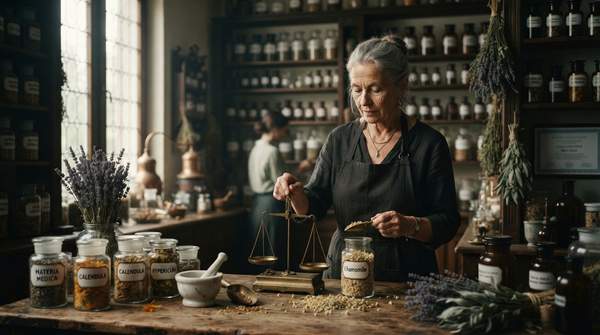
The European apothecary is one of the longest-lived institutions in health care: a shop and workshop where plant-based remedies were grown, compounded, and dispensed to the community. Its story runs from Egyptian temple pharmacies through medieval separation from physicians, a nineteenth-century split into modern pharmacy, and a contemporary revival in which the word "apothecary" has been reclaimed by natural wellness businesses. That same history is now written into law: the European Union's framework for Traditional Herbal Medicinal Products explicitly accepts long-standing bibliographic records of traditional use as evidence in simplified registrations.
The Ancient Roots of Herbal Healing
Historical accounts trace the apothecary's origins to ancient Egypt, Mesopotamia, and Greece, where healers, herbalists, and wise women cultivated botanical remedies and concocted medicinal potions. In ancient Egypt specifically, temples housed sacred pharmacies in which priests and physicians prepared herbal remedies, perfumes, and embalming agents for both medicinal and ritual purposes.
Written records of this knowledge appeared early. The Ebers Papyrus, believed to have been written around 1550 BCE, is one of the oldest preserved medical texts; it describes 500 natural materials and medicinal plants and their properties. Europe, as historians of phytotherapy note, holds a significant portion of the recorded history of medicinal plant use, a lineage that later apothecaries would inherit and expand.
Medieval Monasteries and the Rise of the European Apothecary
Before the twelfth century, pharmacy in Europe was not a distinct calling. Accounts of pharmacy history describe apothecaries working alongside priests and physicians in patient care, with the preparation of remedies treated as part of medicine itself rather than a separate craft. Knowledge of plants passed through texts, gardens, and hands rather than through a defined profession.
The decisive change came in the twelfth century, when the professions of physician and apothecary began to formally separate in Europe. Apothecaries emerged as dedicated centers for the preparation of medications and for learning, a separation later reinforced by imperial decree—most famously Emperor Frederick II's 1240 decree. From this point, the apothecary existed as a recognizable institution with its own identity, training, and civic role.
Apothecaries as Community Health Hubs
Once established, the apothecary became far more than a dispensary. As pharmacy historian Marcelo Murad recounts, apothecaries were places of learning where pharmacy students refined their skills under master apothecaries, and these establishments played a vital role in preserving and disseminating pharmaceutical knowledge across generations.
Their reputation rested on a personalized approach: an apothecary who understood the different effects of substances could tailor preparations to the individual, and this competence earned the trust of communities over centuries. The shop was simultaneously workshop, school, and consultation room—the practical point where herbal knowledge met the health needs of ordinary people.
The Divergence: Traditional Apothecary to Modern Pharmacy
The traditional model eventually gave way to a new profession. Pharmacy as a modern, independent science dates only to the first third of the nineteenth century; before then, it had evolved since antiquity as part of medicine. The nineteenth century thus marks the transition from herbal compounding toward chemically oriented pharmaceutical practice.
Yet the break was not total. Historical analyses of the institution argue that the spirit of the apothecary endures in contemporary pharmacy practice—pharmacists remain trusted health care providers, medication experts, and advocates for patient safety, and modern pharmacies preserve the legacy through personalized medication counseling, compounding services, and holistic patient care. The divergence created modern pharmacy, but it did not erase the apothecary's ethos.
Apothecary Evolution: A Historical Timeline
The chronology below sequences the institution's key milestones, from ancient temple pharmacies to the modern regulatory framework and wellness revival, showing how its role shifted over millennia.
| Era / Period | Key Developments in Apothecary Practice | Notable Influences |
|---|---|---|
| Ancient civilizations (Egypt, Mesopotamia, Greece) | Healers, herbalists, and wise women cultivated botanical remedies; Egyptian temples housed sacred pharmacies where priests and physicians prepared herbal remedies. | Early written herbal knowledge, including the Ebers Papyrus (c. 1550 BCE), describing 500 natural materials and medicinal plants. |
| 12th-century Europe | The professions of physician and apothecary formally separated; apothecaries became centers for medication preparation and learning. | Formalized by decrees, including Emperor Frederick II's in 1240. |
| Centuries following separation | Apothecaries served as community health hubs and places of learning where students trained under master apothecaries, preserving and disseminating pharmaceutical knowledge. | Personalized care and trust built the profession's reputation. |
| 19th century onwards | Pharmacy emerged as a modern, independent science, marking the transition from traditional apothecaries to modern pharmacies. | Evolution from traditional herbal remedies toward modern pharmaceuticals. |
| Modern natural wellness movement | The term "apothecary" is revived by businesses focused on herbalism, natural remedies, and holistic wellness, emphasizing education and ethically sourced products. | Contemporary interest in plant-based medicine and community-focused health. |
| EU regulatory framework | Directive 2004/24/EC allows simplified registration of Traditional Herbal Medicinal Products based on historical bibliographic evidence of traditional use. | Acknowledges the long-standing tradition of herbal medicine in Europe. |
Read together, the rows trace one continuous arc: an institution born in sacred settings, professionalized in medieval Europe, displaced by scientific pharmacy, and then revived—first commercially, then legally—as a model for traditional plant-based care.
The Modern Revival: Natural Wellness and the 'New' Apothecary
The most visible sign of the revival is linguistic. Businesses centered on herbalism, natural remedies, and holistic wellness have adopted the "apothecary" name, emphasizing education and ethically sourced products. The label signals continuity with the historical shop: a knowledgeable guide, natural ingredients, and a community orientation rather than anonymous mass retail.
Researchers studying Europe's heritage of folk medicine argue that this revival has scientific as well as cultural significance. Writing on the European heritage of folk medicines, they identify a pressing need to connect the evidence-based use of medicinal plants to emerging, culturally sensitive models of healing, and point to medical ethnobiology—the interdisciplinary study of traditional and folk uses of plants in both rural and urban settings—as a key turning point in that effort.
Traditional Use and European Herbal Medicine Regulation
History also became legal evidence. The pan-European Directive 65/65/EWG, Article 4.8 a(ii), established a simplified market approval pathway for known natural and synthetic substances based on bibliographic evidence. Building on that framework, EU Directive 2004/24/EC continued to recognize bibliographic or traditional-use data as primary evidence for registering herbal ingredients or products under a simplified category—Traditional Herbal Medicinal Products (THMPs)—with the Committee on Herbal Medicinal Products developing EU community herbal monographs to support registration and free movement of these products among member states.
In effect, the apothecary's accumulated record became a regulatory asset. Research on this framework demonstrates that historical and present-day phytotherapy textbooks can serve as reliable sources of evidence on the effectiveness and safety of traditional plant medicines within the European medical tradition—records of intergenerational, practice-based expert knowledge that are sometimes validated through contemporary randomized controlled trials, and that represent one of the most comprehensive records of therapeutic plant use within the European materia medica.
The Enduring Legacy of the European Apothecary
Readers should recognize the deep historical roots of natural wellness practices and appreciate how the traditional apothecary's principles continue to influence modern health choices and regulatory approaches. The practical payoff is increased recognition and informed engagement with "apothecary" labeled products or services, understanding their historical context and regulatory basis: when a modern shop borrows the name, it invokes an institution traceable to Egyptian temple pharmacies, professionalized by twelfth-century decrees, and whose records of traditional use now carry formal weight under Directive 2004/24/EC. That lineage—rather than any claim about a specific remedy's efficacy—is what the word genuinely certifies.
Sources
- Prime Scholars | Open Access Journals
- ABC Herbalgram Website
- ABC Herbalgram Website
- The European Heritage of Folk Medicines and Medicinal Foods: Its Contribution to the CAMs of Tomorrow - PMC
- Brief History of Pharmacy: Past and Future - Opuspac University
- History of pharmacy - Wikipedia — EN
- Herbs in History, Legend and Lore — UC Agriculture and Natural Resources