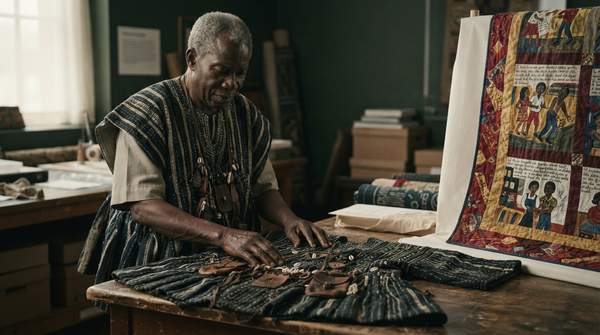
Textiles tell stories in two fundamentally different voices. In the Loho community of Northern Ghana, woven smocks operate as a collective archive: their motifs reference historical events, proverbs, totems and spiritual concepts that a whole community can read. In contemporary American fiber art, artists such as Faith Ringgold and Tanya Aguiñiga use fabric to narrate personal memory and political protest, with meaning anchored in an individual's intent. The difference is not one of sophistication but of narrative mode—one system is shared and inherited, the other authored and declared.
Textiles as Narrative Documents: An Introduction
A length of cloth can do the work of a chronicle. It can record what a community believes, what it has survived, and what it expects of its members—without a single written word. What varies across cultures is not whether textiles carry meaning, but where that meaning originates and how it is transmitted.
An ethnographic study of weaving in the Loho community of Northern Ghana found that pattern knowledge there is inseparable from storytelling: weavers explained the significance of designs through cultural stories that placed technical knowledge within broader social contexts. On the other side of the world, the fiber artist Carolina Oneto, writing about fabric art, describes quilts that preserve life experiences through cloth. These two cases—Northern Ghanaian weaving and modern American fiber art—are the illustrative anchors of this article, not a universal decoding guide for every textile.
Traditional Storytelling: Ghanaian Smocks as Cultural Archives
The Ghanaian research rests on extended conversations with weavers and on participant observation: the study's first author immersed himself in the daily rhythms of weaving workshops and community spaces. Through those conversations, the weavers shared narratives of their apprenticeships and described how techniques had changed over time—so even the practice of weaving carries its own history of transmission.
The finished cloth carries history too. Community members explained that completed textiles hold deep cultural heritage through their patterns, and that specific textiles were required to properly mark occasions, with each design element carrying its own cultural meaning. In this system, a smock is not merely clothing. It is a document in which history, belief and social protocol are woven together—a garment whose correctness matters because what it records matters.