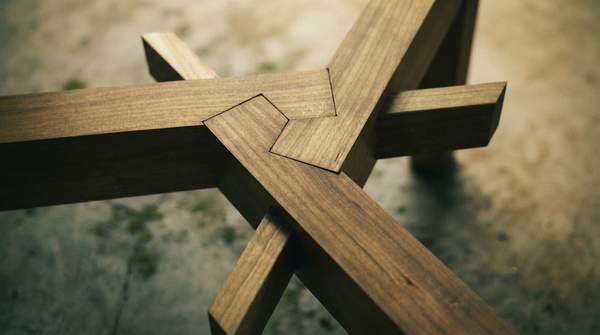
The defining idea of traditional Japanese wood joinery is a quiet paradox: structures held together by nothing but shaped wood. Sashimono, the joinery tradition behind furniture and cabinetry, builds pieces “without the use of nails or screws of any kind,” as Andrew Cousins notes in the BYU Design Review. Kumiki, its lattice-building cousin, interlocks small wooden members into geometric patterns that carry load and decoration at once. Together, these two techniques show how Japanese woodworkers turned the absence of metal fasteners into both an engineering discipline and an aesthetic philosophy.
The Enduring Art of Japanese Wood Joinery
Japanese woodcraft has evolved over a thousand years, accumulating techniques ranging from marquetry and wood bending to intricate joinery and delicate inlay, according to the Japan Woodcraft Association. Within that family, joinery holds a special place: it is the craft that allows entire structures, from kitchen utensils to Buddhist shrines, to be assembled from wood alone.
Two broad categories organize the field. The first is furniture and cabinetry joinery, represented by Sashimono, where a cabinetmaker cuts mating surfaces so precisely that a joint holds by fit rather than by fastener. The second is structural and decorative lattice work, represented by Kumiki, where many small pieces lock into a self-supporting geometric whole.
What links them is not just the absence of nails but a shared way of thinking about wood. The craftsman studies the material’s grain, hardness and behavior, and then designs a joint in which the wood’s own properties do the structural work. The result, Cousins observes of sashimono, is “a beautiful blend of art, engineering, and design,” and the same could be said of kumiki’s interlocking geometry.
Sashimono: Precision in Furniture and Cabinetry
Sashimono is the tradition of making furniture without nails or screws. Its earliest origins reach back to the Heian period, between 794 and 1185, and it rose to greater prominence during the Muromachi era, between 1382 and 1573, when fabrication specialists applied it to ceremonial tea chests. In Japan, Cousins writes, “everything from kitchen utensils to Buddhist shrines have been constructed through sashimono techniques.”
Structurally, sashimono depends on the expert’s judgment about which joint to employ in which place. Sashimono specialists, as Cousins puts it, “know what joints to employ to get the best outcome, allowing them to build pieces that can last decades and centuries.” The strength of a chest or shrine is distributed across many precisely mated connections, each cut to transfer load through compression and friction between wooden surfaces rather than through a metal pin.
Aesthetically, sashimono is defined by restraint. Its joints are frequently hidden completely from sight, so that a finished piece presents uninterrupted wood grain and clean planes. The refinement you see on the surface is inseparable from the precision you cannot see inside: the cleaner the visible form, the more exacting the hidden joinery behind it.