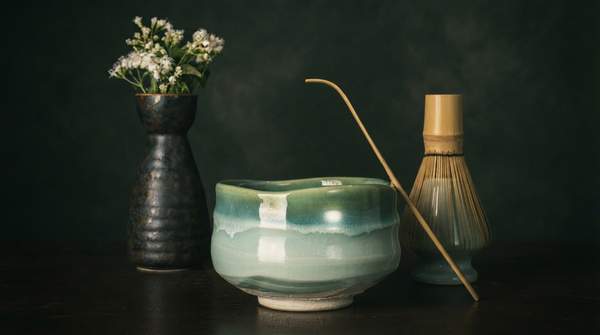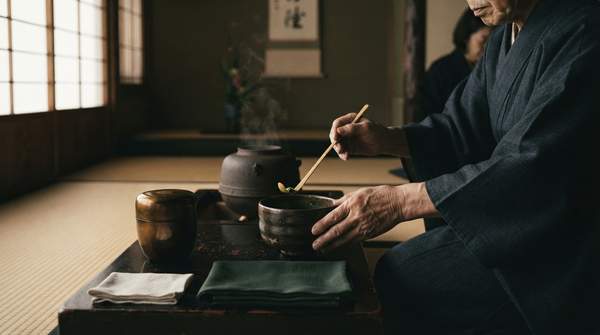
A Japanese tea ceremony depends on far more than the three objects most people can name: the chawan (tea bowl), the chasen (whisk), and the chashaku (scoop). Around these familiar tools orbits a wider set of utensils — the iron kettle that heats the water, the lacquered caddy that holds the tea, the silk and linen cloths that purify each vessel — and each carries its own function, material logic, and symbolic weight. Understanding these objects is the difference between watching a ritual and reading it.
Beyond the Basics: Unveiling Key Tea Ceremony Utensils
The full family of tea utensils is known in Japanese as chadogu, and together they form what is often called sado or "the way of tea." What distinguishes chanoyu from ordinary tea preparation is that the utensils are not merely equipment: they are treated as objects of appreciation in their own right. Writing about a Washington DC exhibition of tea utensils, Asian Art Newspaper notes that such objects accumulated significance "over generations through their continued use and display at tea gatherings," and that practitioners have even cherished the accompanying boxes, documents, and textiles that record an object's layered history.
Not every utensil serves the same role, however. Some heat water, some hold and present the tea itself, and others exist purely for purification — the ritual cleaning of vessels that frames each gesture of the temae, the ordered procedure of preparing tea. This article focuses on that preparation-and-serving set (the temae dogu) and leaves aside the tools of the preparation area and the kaiseki meal, as well as the countless school-specific variations that a full study of chanoyu would entail.
The Heart of the Ceremony: Water Heating Utensils
Every bowl of matcha begins with water, and the vessel that heats it is among the ceremony's most imposing objects. The traditional cast-iron kettle — the tetsubin, closely related to the broader kama used in chanoyu — has been used for centuries to heat water and is described by Tokyo Matcha Academy as an important tool in sado. Its virtues are practical first: the iron heats water evenly and retains heat well, and it is believed to improve the taste of the water by releasing small amounts of iron, which is said to create a smoother flavour for preparing matcha.
But the kettle is also an aesthetic anchor. The same source observes that its beautifully crafted cast-iron body "reflects the artistry and simplicity valued in Japanese culture." A tea kettle in the Spurlock Museum's collection, paired with a brazier and dated by donor records to the Taishō period (1912–1926), was identified by Diana Liao of the University of Illinois' Japan House as an intentionally matched set — a reminder that kettles are chosen in deliberate combination with other objects rather than in isolation. Depending on the season, the kettle is placed either on a portable brazier (furo) or over a sunken hearth, so even the setting of the kettle marks the time of year.
Key Tea Ceremony Utensils Beyond the Basics
The table below gathers the less familiar utensils into one comparison, organized by the job each performs in the temae. The reasoning behind each pairing of material and function is drawn from the descriptions above: iron for even heat and durable presence, lacquered wood for a caddy meant to be seen and handled, and silk or linen for cloths whose entire purpose is purification.
| Utensil (Japanese Name) | Primary Function | Typical Materials | Symbolic/Aesthetic Significance |
|---|---|---|---|
| Kama / Tetsubin (釜 / 鉄瓶) | Boiling and holding the hot water for the tea; placed on a brazier or over a sunken hearth depending on the season | Cast iron | Reflects the artistry and simplicity valued in Japanese culture; its even heating and slight release of iron are said to smooth the water's flavour; contributes to the overall aesthetic of the tea setting |
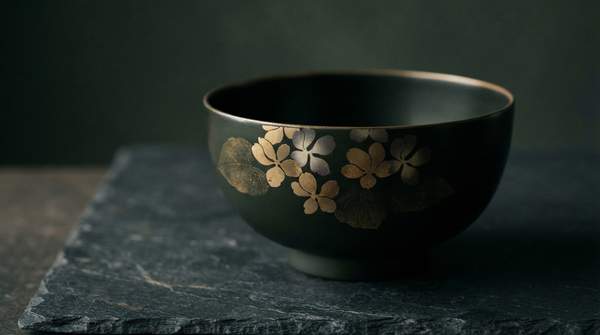
| Natsume (棗) | Storing and presenting the thin tea (usucha) powder during the preparation | Lacquered wood (urushi-nuri), often decorated with gold and silver powder by master artists | A functional tool and artistic element showing the host's aesthetic sensibility; its design reflects seasonal harmony and expresses hospitality; part of the toriawase, the art of selecting utensils for an occasion |
| Fukusa (silk cloth) | Ritually purifying utensils such as the tea caddy and scoop during the temae; paired with the natsume in use | Silk (with the shifuku, a fabric pouch, as an alternative covering for the caddy) | Turns cleaning into a visible, deliberate act of respect; the careful folding and handling embody the ceremony's attentiveness toward objects and guests |
| Chakin (linen cloth) | Wiping the tea bowl; folded in a very specific learned manner | Linen | Its precise folding sequence makes even hygiene a disciplined, graceful gesture within the ritual |
Read this way, the table shows a division of labour: the kettle governs water, the natsume governs tea, and the two cloths govern purity. No single object can substitute for another, because each answers a different requirement of the temae — heat, containment, and purification.
Containers of Tradition: The Natsume Tea Caddy
Of these less familiar utensils, the natsume rewards the closest attention. It is a distinct type of tea caddy — one of the two major forms, alongside the ceramic chaire — used specifically for usucha, the thinner style of matcha. In the 16th century, as Asian Art Newspaper recounts, the Japanese tea caddy "held the crucial role of storing and presenting matcha, serving as both a functional tool and an artistic element that displayed the host's aesthetic sensibilities and contributed to the ceremony's overall atmosphere of wabi-sabi."
The natsume has been used since the 14th century, according to Tokyo Matcha Academy, and is typically made of lacquered wood. It is typically paired with a fukusa or shifuku — two different types of fabric used to purify or protect the caddy. The craftsmanship itself is an art: master urushi-nuri lacquer artists use gold and silver powder to carve delicate patterns into what would otherwise be simple containers. The result is an object small enough to sit in the palm of the host's hand, yet dense with deliberate design.
The Art of Purification: Fukusa and Chakin
The cloths used in chanoyu carry no tea and heat no water, yet the ceremony would be incoherent without them. The fukusa is a silk cloth with which the host ritually purifies utensils such as the tea caddy and the scoop, each fold and wipe performed in a fixed order that guests follow with their eyes. The chakin, by contrast, is the linen cloth used to wipe the tea bowl, and it too is folded into a very specific manner — a sequence that practitioners learn explicitly rather than improvise.
The significance of these cloths lies precisely in their modesty. A basic utensil list for a proper tea-drinking ritual, as outlined by the byFood team, places the fukusa and the tea caddy alongside the matcha itself and the bowl and whisk — evidence that purification is not an optional grace note but one of the ceremony's structural elements. In a ritual where every gesture is witnessed, the act of cleaning a container becomes a statement of respect: for the object, for the tea, and for the guest who will receive it.
Seasonality and Hospitality: The Host's Expression
What elevates these utensils from equipment to expression is the practice of choosing them for each specific gathering. In the 16th century, as noted above, the choice of tea caddy was already "an integral part of the toriawase — the art of selecting utensils for a specific occasion." The host does not simply own a natsume; the host chooses one.
The natsume's decoration is the clearest window into this. Its design reflects seasonal harmony: images of cherry blossoms for spring or autumn leaves for fall, linking those participating in the ceremony to the time of year. Through these motifs the host expresses hospitality and the transient beauty of nature, and — as Tokyo Matcha Academy describes — can thoughtfully choose a design for each guest that sets the tone for the ritual. The caddy becomes a greeting made in lacquer and gold before a word of welcome is spoken.
The kettle participates in the same language. Its placement shifts with the seasons — brazier in the warm months, sunken hearth in the cold — and historical sets, like the intentionally paired Taishō-era kama and furo in the Spurlock collection, show that pairing and proportion have long been part of the host's statement. Together with the natsume and the purifying cloths, the kettle demonstrates that every element of the temae can be tuned to a particular day, a particular guest, and a particular moment in the year.
Appreciating the Artistry of Chanoyu Utensils
To fully appreciate the Japanese tea ceremony, pay attention to the specific function, material, and symbolic design of each utensil beyond the chawan, chashaku, and chasen. The measurable indicator of that appreciation is simple: the ability to identify and articulate the purpose of a kama, natsume, or fukusa when observing or participating in a tea ceremony. When you can watch a host lift a cast-iron kettle from its brazier, purify a lacquered caddy with a silk cloth, and read the season in the gold pattern on its lid, the ceremony stops being a sequence of graceful motions and becomes legible as a conversation between host, guest, and the moment they share.
Sources
- Recommended Tools for Beginners to Tea Ceremony (盆略点前) - Tokyo Matcha Academy — Tokyo Matcha Academy - The Best Matcha Kimono Tea Ceremony Experience in Tokyo!
- Japanese Tea Utensils — Asian Art Newspaper
- Ripples of Change in Tea Culture — Spurlock
- Japanese Tea Ceremonies: History, Etiquette & Experiences — BYFOOD