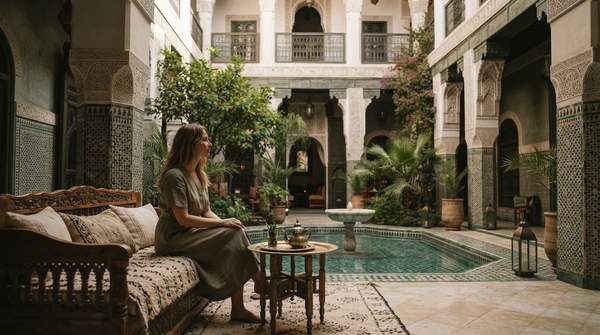
Walk down a lane in the Marrakech or Fez medina and you may pass a riad without knowing it. The exterior offers almost nothing: high, windowless walls of rammed earth or mud brick, a plain door. Step inside, though, and the building opens toward the sky — a planted courtyard, a fountain, light pouring onto patterned tilework. This contrast is not an accident of style. It is the entire point. The traditional Moroccan riad is an inward-facing house whose architecture directly expresses cultural values of privacy, family and hospitality, and that same design now makes riads a natural home for slow travelers seeking immersion rather than a conventional hotel stay.
Inward-Facing Design: Privacy and Tranquility
The defining move of riad architecture is that virtually everything faces inward. Rooms open onto a central courtyard rather than onto the street, and the exterior walls remain deliberately discreet — what one architectural overview describes as a design that "allowed for family privacy and protection from the weather."
That discretion carries meaning. As a heritage collection account of riad hotels puts it, the modest exterior embracing layered interiors reflects Morocco's Islamic values and the concept of "paradise on Earth." A design commentary from Leonis Collection, authored by Laafar El Mehdi, makes a similar point: the architecture "creates a transition between the intensity of the city outside and the quieter rhythm of the home within."
So when you stand in a riad's silent courtyard and hear only water and birdsong while the medina roars a few meters away, you are experiencing exactly what the builders intended: a private world turned away from public life.
Key Architectural Elements of a Traditional Riad
Historically, these were the homes of wealthy families, merchants and urban elites in cities like Marrakech, Fez and Essaouira. The typical layout repeats a small set of elements with remarkable consistency, each serving both comfort and culture. The courtyard is the organizing heart, often planted with fruit trees such as orange or lemon, and usually holding a fountain or pool. Around it, galleries and rooms face the garden. Above, a rooftop terrace adds open-air living space.
The table below maps each component to the principle behind it, the function it performs, and how it survives in today's riad hotels — so you can read any riad you enter like a text.