Bharat Parv 2026, running from October 30 to November 15 at Ekta Nagar in Gujarat, is showcasing India's cultural heritage through dedicated pavilions for States and Union Territories, craft stalls, a pan-India food court and a continuous program of folk and classical performances. Organized as part of the Rashtriya Ekta Diwas celebrations, the festival operates under the theme of 'Ek Bharat Shreshtha Bharat', presenting regional traditions from across the country at a single destination. Early attendance has been substantial: a news report on the festival notes that more than 25,000 visitors came in its first three days.
Bharat Parv 2026: Cultural Experiences at a Glance
The festival's offerings can be grouped into three core pillars, each drawing on the distinct identities of participating States and Union Territories. The table below classifies the main categories and names specific examples reported from the event.
| Category | Description | Specific Examples |
|---|---|---|
| Performing Arts | Folk and classical traditions presented by performers from various States and Union Territories | Kuchipudi, Bihu, Garba and Tholpavakoothu, among other forms reported by DD India |
| Traditional Crafts & Handlooms | Artisan demonstrations, curated displays and direct sales of indigenous products | Patola, Pithora art and Ajrakh printing from Gujarat; bamboo crafts from Chhattisgarh; shell art from the Andaman and Nicobar Islands |
| Regional Cuisine | A pan-India food court with traditional delicacies, street items and desserts | Dishes representing 23 states, including Maharashtra, Karnataka, Sikkim, Assam, Ladakh, Tamil Nadu, West Bengal and Gujarat |
Each category is supported by a different physical structure at the festival: pavilions for the States and Union Territories, craft stalls with live demonstrations, and a food court paired with a 'Studio Kitchen' for culinary workshops. Together they form the practical map of a visitor's day at Ekta Nagar.
Performing Arts: A Kaleidoscope of Indian Dance and Music
According to the Press Information Bureau, the festival features a vibrant line-up of cultural performances representing the diverse folk and classical traditions of States and Union Territories. Reporting by DD India names several of the forms on display: Kuchipudi, Bihu, Garba and Tholpavakoothu, each carrying the imprint of its home region into the festival grounds.
The variety is deliberate rather than incidental. By placing classical dance alongside regional folk forms, the program lets visitors move between traditions of very different character within a single evening—precisely the kind of juxtaposition the festival's theme of unity in diversity is designed to create. The performances are not treated as background entertainment; they are one of the principal ways the festival communicates the cultural identities of the participating regions.
Traditional Crafts and Handlooms: Showcasing Artisan Skill
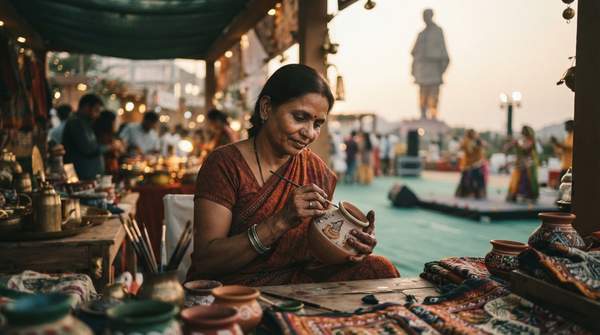
The craft stalls are the festival's most tactile offering. Reporting on the event lists Gujarat showcasing its iconic Patola weaving, Pithora art and Ajrakh printing, alongside bamboo crafts from Chhattisgarh and shell art products from the Andaman and Nicobar Islands. The PIB release describes the exhibits as spanning intricately crafted textiles and handloom products, traditional paintings and handicrafts, offering visitors a glimpse of India's diverse indigenous products and craft traditions.
What distinguishes the crafts section from a conventional exhibition is direct contact with the makers. As the PIB notes, demonstrations provide a platform for artisans to showcase their skills and introduce visitors to traditional art forms, techniques and indigenous knowledge systems passed down through generations. Visitors can watch artisans work, learn traditional craft-making techniques and purchase authentic handicraft and handloom products directly from the participating pavilions—turning spectators into patrons of living traditions rather than only observers.
Regional Cuisines: A Culinary Journey Across India
The food court is the most popular expression of the festival's breadth. According to DD India's report, it features dishes from 23 states, with reporting naming Maharashtra, Karnataka, Sikkim, Assam, Ladakh, Tamil Nadu, West Bengal and Gujarat among those represented. The menu spans traditional regional delicacies, local street items and authentic desserts.
Beyond the stalls, the event's official page describes a 'Studio Kitchen' that brings the diverse culinary traditions of India to Ekta Nagar, with reporting indicating it hosts culinary workshops. The Incredible India pavilion adds a further layer, highlighting the country's heritage, culture and festivals through engaging digital interventions. For visitors, the food court functions as an edible atlas of the country—the most immediate way to sample, in one place, cuisines that would otherwise require journeys across several thousand kilometers.
Embodying 'Ek Bharat Shreshtha Bharat'
The festival's theme is not a slogan attached to the program; it is embodied in the event's architecture. According to the Incredible India event page, the exhibition features dedicated pavilions representing various States and Union Territories, each showcasing its cultural heritage, traditional art and crafts, handloom and handicrafts, cuisine, tourism attractions and regional specialties.
Every pavilion provides an opportunity to experience the distinct identity, traditions and tourism potential of the respective State or UT through curated displays, cultural presentations, local products and food offerings. The effect is structural: no single region is positioned as the norm, and each is presented as complete in itself while contributing to a shared national picture. DD India's report frames the festival's purpose in the same terms—strengthening the spirit of 'Ek Bharat Shreshtha Bharat' by promoting cultural exchange, national integration and the idea of unity in diversity, while highlighting the role of local traditions, crafts and cuisine in enriching tourism experiences.
By bringing locally renowned products onto a national platform, as the PIB release puts it, the festival enhances the visibility of regional craftsmanship, promotes traditional skills and encourages appreciation of the work of local artisans and craftspeople. The theme thus operates in both directions: visitors encounter unfamiliar traditions, and participating regions gain a stage their crafts rarely receive.
Experiencing 'Ek Bharat Shreshtha Bharat'
Visitors to Bharat Parv 2026 can actively engage with India's cultural diversity and witness the 'Ek Bharat Shreshtha Bharat' theme in action—whether by watching Kuchipudi and Bihu performed on the same program, buying Ajrakh-printed cloth from an artisan demonstrating the technique, or tasting dishes from 23 states in a single food court. The measurable indicator of the theme's reach is continued high visitor turnout and positive media coverage highlighting the cultural exchange and unity the festival promotes. With more than 25,000 visitors in its first three days and the festival continuing until November 15, that indicator is already trending strongly. The examples here are illustrative rather than exhaustive, drawn from available reports of an ongoing event.
Sources
- Gujarat: Bharat Parv 2026 draws 25,000 visitors, celebrates India's cultural diversity — Big News Network.com
- Bharat Parv 2026 Celebrates India’s Cultural Diversity at Gujarat’s Ekta Nagar - DD India
- Bharat Parv 2026 Showcases India’s Rich Cultural Heritage and Diversity at Ekta Nagar, Gujarat — PIB
- Bharat Parv 2026 :: Rashtriya Ekta Diwas 2026 — Rashtriyaektadiwas
- Bharat parv — Incredible India