Some of the world's most remarkable textiles were never meant to hang quietly on a wall. When you compare three traditions from three continents—Kuba raffia cloth from the Democratic Republic of the Congo, Kente cloth from Ghana, and Incan quipus from the Andes—a pattern emerges that goes well beyond aesthetics: fiber, knot, and strip have all served as working systems for communication, record-keeping, and social rank. Here is how each one does it, and how to tell them apart at a glance.
Kuba Cloth: Geometric Narratives from Central Africa
Kuba cloth comes from the Kuba Kingdom, a federation of neighboring tribes in Central Africa that, according to the George Washington University Museum and The Textile Museum, united from the 17th to the 20th century. The base material is raffia palm fiber: historically, men cultivated the palms and wove strips of cloth, while women stitched the pieces together, dyed them, and embellished them with bold geometric patterns.
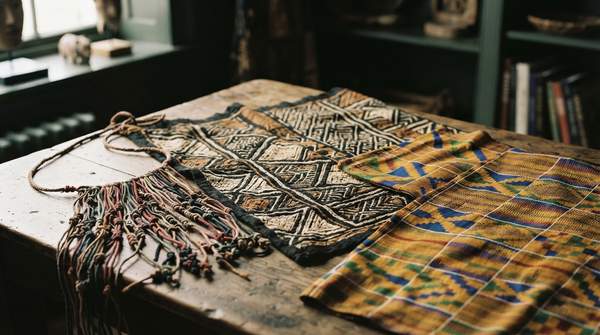
The embellishment is where the artistry lives. Artisans work embroidery, appliqué, and cut-pile techniques over the woven raffia base, and the cut-pile method produces a texture often described as velvet-like. The result is a cloth that is as much sculpture as fabric—raised, rhythmic, and deliberately irregular.
Those patterns carry content. The museum notes that hundreds of patterns exist to describe events, objects, or places, and to honor the maker or the recipient. Writing on the meaning behind the designs, Manny of Logic & Linen observes that Kuba geometry "isn't decoration for its own sake": a motif establishes a beat, then the maker introduces deliberate variations, breaks, inversions, and shifts so the eye never settles. Art historians have compared the effect to jazz improvisation, which is part of why the cloth captivated modern artists like Matisse and Klee.
Nor was this everyday wear. Congolese textiles functioned as essential elements in major life transitions—births, marriages, deaths, initiations, and celebrations of leadership—with the finest cloths wrapping the bodies of the high-status dead. Raffia working itself extends across multiple communities, including the Bushong and the Shoowa, each with distinct techniques and contexts.
Kente Cloth: Woven Status and Proverbs of Ghana
Kente cloth belongs to West Africa's long stripweaving tradition. As Textile School explains, narrow strips are woven on a double-heddle loom and then sewn together to form larger textiles. The cloth is therefore built in modules: each strip carries its own pattern, and the assembled whole is a composite of many woven decisions rather than a single continuous picture.
What elevates Kente is its naming system. Each strip's pattern is often named after proverbs or historical events, so the cloth contributes to a narrative before a word is spoken. The wearer is, in effect, quoting—wrapping themselves in a saying or a remembered moment.
The social function follows directly. Kente is worn during important events in Ghana, symbolizing status and heritage, and within indigenous communities such textiles retain their ceremonial and social significance. It is a cloth of occasion and identity, its meaning declared as much by when it appears as by how it looks.
Incan Quipus: Knotted Records of the Andes
The quipu breaks the category entirely: it is a textile that is also a database. Made from cotton or wool cords dyed in various colors, quipus served as a visual language through which the Inca recorded important information—census data, historical events, and economic records.
The information lives in the knots. As the fiber-arts guide by Sarazen AnYin describes, each knot signifies specific information, and the position, color, and type of knot all denote different knowledge. A reader of a quipu was not admiring a pattern but parsing one.
There is an honest limit to what we can recover. The explicit meanings of historic quipus have been lost, even though the system's structure—knot, position, color—is understood. And the cords were also dyed in vibrant colors, arranged with techniques that made each quipu a striking and aesthetically pleasing object. Record-keeping and artistic expression shared the same cords.
Comparative Overview of Traditional Fiber Arts
Setting the three side by side reveals how differently each tradition solves the same underlying problem—making fiber carry meaning. The table below compares them across consistent dimensions: origin, material, construction, and purpose.
| Dimension | Kuba Raffia Cloth | Ghanaian Kente Cloth | Incan Quipus |
|---|---|---|---|
| Region / Culture | Kuba Kingdom, Central Africa (Democratic Republic of the Congo); tribes united from the 17th to 20th century | Ghana, West Africa | Inca Empire, Andes, South America |
| Primary Material | Raffia palm fiber, with cotton thread and pigment in surviving skirts | Woven strips of fabric | Cotton or wool cords, dyed in various colors |
| Construction Technique | Woven raffia base embellished with embroidery, appliqué, and cut-pile work for a velvet-like texture | Stripweaving: narrow strips woven on a double-heddle loom, then sewn together | Knotting: position, color, and type of knot each denote different knowledge |
| Primary Function | Status symbol and ceremonial cloth; hundreds of patterns describe events, objects, places, and honor maker or recipient | Worn at important events to symbolize status and heritage; patterns often named for proverbs or historical events | Record-keeping of census data, historical events, and economic records; also artistic expression |
Read across the rows and the distinctions sharpen. Kuba builds meaning on the surface of a woven base; Kente builds it into the woven strip itself; the quipu dispenses with fabric altogether and encodes meaning in knots. Two are worn, one is read. Two survive with their meanings intact, while the quipu's explicit contents are lost even as its system is understood.
Beyond Decoration: Textiles as Communication and Symbolism
What unites these three traditions is that none of them is primarily about beauty. Kuba patterns describe events and honor people; Kente strips quote proverbs and mark status; quipu knots hold census figures and economic records. In each case, the textile is a medium—closer to writing, recitation, or ledger-keeping than to ornament.
The comparison also shows three different technologies of meaning. Kuba works through surface variation: a base cloth altered by embroidery, appliqué, and cut-pile, with rhythm and deliberate shifts doing the expressive work. Kente works through naming and assembly: modular strips, each carrying a proverb or event, joined into a larger whole. The quipu works through code: a structured system in which knot type, position, and color each denote different knowledge.
For a modern home or wardrobe, this changes what you are looking at. A Kuba-inspired piece is a focal point with a sculptural, high-contrast surface; as Logic & Linen suggests, one strong piece beats five competing ones. A Kente cloth is a wearable citation, its meaning tied to occasion. A quipu is a reminder that a "textile" can be an archive—vivid to the eye, dense with data we can no longer fully read.
Appreciating the Enduring Legacy of Textile Arts
Approach traditional textile arts as what they are: complex systems of communication, record-keeping, and social symbolism, not merely decorative items. The practical test is simple. The next time you encounter one of these traditions, you should be able to identify and articulate the non-decorative functions—communication, status, record-keeping—of at least two of them. If you can look at a raffia panel and see a described event, or at a knotted cord and see a census, you are reading the cloth the way its makers intended.
Sources
- Textile Traditions | The George Washington University Museum and The Textile Museum
- The Meaning Behind Kuba Cloth Patterns (and Why Designers Love Them) — Logic & Linen
- Exploring Indigenous Textile Techniques: Preserving Global Cultural Heritage — Textile School
- Complete Guide to (57) Almost All Types of Fiber Arts with Photos - Fiber Art by Sarazen AnYin