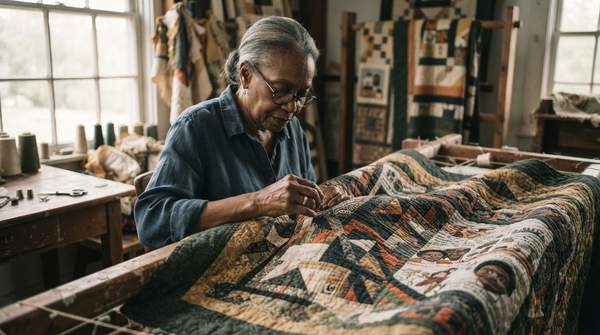
Quilting began as a solution to a basic problem—keeping people warm with limited material—and became one of the most eloquent textile traditions in American and European culture. Individual quilts are now sought out as historical documents in their own right, writes Tracy L. Vaughn-Manley, a Northwestern University scholar who describes the quilt as a record of "the range of the Black American experience." The arc of that transformation runs from the domestic economy of early patchwork, through the communities of enslaved Black Americans and the wartime home front, and into museums and galleries where quilts are recognized today as art. Understanding that arc means understanding how necessity, storytelling, and community were stitched together from the very beginning.
Early Origins and Utilitarian Roots
The Victoria and Albert Museum distinguishes quilting from patchwork by temperament: if quilting is associated with warmth and protection, patchwork is bound to domestic economy—"a way of using up scraps of fabrics or of extending the working life of clothing." Patchwork remained a predominantly domestic rather than professional undertaking, and its logic was conservation. Nothing usable was thrown away; worn clothing was cut down, recombined, and given a second life as a bed covering.
Yet the earliest chapters of this history already show the craft exceeding pure utility. The V&A's collection includes patchwork quilts made from significant amounts of specially bought fabric, objects attributed to middle-class women making them "for pleasure rather than necessity." Even at its most resourceful, the form carried an impulse toward decoration, arrangement, and personal taste. The pattern— deciding which scraps sit beside which—was a composition long before anyone called it art. That duality, thrift and expression sharing one cloth, is the seed from which everything else in quilting's history grows.
Resourcefulness was not simply a matter of household economy, either. It was shaped by the political economy of cloth itself. When the Industrial Revolution made fabric more affordable and widely available, as Iowa State University Museums notes in its own historical accounts of quilts, the craft broadened: more people could obtain material, and quilting's creative potential expanded accordingly. The relationship between what fabric cost and what a quilt could mean runs like a thread through every era that follows.
The Evolving Tapestry of Quilting: A Historical Timeline
Read chronologically, the major developments in quilting line up with the pressures and possibilities of each era—necessity in one period, cultural preservation in another, artistic ambition in the last. The timeline below sequences the key shifts documented in museum, university, and government sources.
| Era/Period | Key Developments & Purpose | Cultural Context/Examples |
|---|---|---|
| Antebellum America & enslaved communities | Quilting, born of necessity, became a means of recording and preserving experience; a tool for storytelling, cultural preservation, and community building. | Quilt historian Gladys-Marie Fry describes quilts made by enslaved Black Americans as communal history recorded "not on paper, but on fabric." |
| Industrial Revolution era | Cheaper, more available fabric broadened quilting's appeal for both practical and artistic expression. | Farm-made quilts such as Lurana Bucklin Hoyt's c. 1870 quilt, held in Iowa State University Museums' Farm House Museum Collection. |
| World War I (U.S. entry, 1917) | The U.S. government requisitioned commercial wool and urged citizens to quilt under the slogan "Make Quilts-Save the Blankets for our Boys Over There." | Utilitarian home quilts from this effort earned the nickname "Liberty Quilts," according to the National Park Service. |
| Early 1900s (1907 onward) | State quilt blocks emerged when Hearth and Home magazine's Fancywork Department invited readers nationwide to contribute pieced block patterns representing their states. | A participatory, community-driven pattern tradition tied to state identity. |
| Late 20th century to present | Quilting gained recognition as a legitimate art form beyond its traditional craft status, encompassing diverse artistic expression. | Contemporary quilts displayed in museums and galleries, valued for artistic merit and personal expression. |
The pattern the table reveals is the article's central finding: each era repurposed quilting toward its own needs—survival, thrift, patriotism, state pride, art—but the underlying capacities for recording and connecting people were present from the start.
Quilting as a Voice: Storytelling and Cultural Preservation
Nowhere is quilting's storytelling power clearer than in Black American history. Vaughn-Manley observes that although quilting within Black American culture "was born out of necessity, their utilitarian purposes also extended into a performative ritual that covered the range of the Black American experience." A bedcovering made from what was available doubled as an assertion that a person's life was worth marking, worth remembering, worth making visible in cloth.
Quilt historian Gladys-Marie Fry, in her study of antebellum quilts and enslaved quilt makers, "Stitched from the Soul: Slave Quilts from the Antebellum South," states it precisely: quilts "became the means by which the enslaved recorded and preserved their experiences—not in words, but in stitches… It was their personal and communal history recorded not on paper, but on fabric." The quilt, in other words, was not merely a product of survival; it was an instrument of memory and cultural recognition when other forms of recording were unavailable.
One popular extension of this story deserves careful handling. The idea that quilts hung on fences and porches carried a secret code guiding freedom-seekers along the Underground Railroad became widespread after the 1999 publication of "Hidden in Plain View" by Jacqueline L. Tobin and Raymond G. Dobard, as the Reading Eagle reported. The notion is popular but controversial, and the National Park Service is blunt: Harriet Tubman never used such a code, "because the quilt code is a myth." Tubman relied on trusted helpers, disguises, rivers, the North Star, and song tempos. The myth does not erase what the quilts genuinely were—objects of profound symbolic and communal meaning—rather, it reminds us that their truth lies in cultural preservation, not cryptography.
Wartime tells a parallel story of necessity turned communal. When the United States entered World War I in 1917, the government took all commercially produced wool and actively urged citizens to quilt with the slogan "Make Quilts-Save the Blankets for our Boys Over There," as the National Park Service recounts. The resulting home quilts, soon nicknamed "Liberty Quilts," fused thrift with patriotism: households conserving domestic resources while contributing to a national effort. Here, too, quilting converted scarcity into meaning.
Evolution into an Art Form: Modern Recognition
The communal thread never broke. The 1907 state quilt block project—Hearth and Home magazine asking readers across the country to contribute pieced block patterns representing their states—shows quilting as participatory culture on a national scale: ordinary makers designing symbols of collective identity, distributed through a farm magazine's pages. From the communal sewing circle to the printed pattern exchange, quilting has always been a practice transferred between people, its skills and stories moving across generations alongside its cloth.
The late twentieth century brought formal recognition. As the National Park Service's historical account notes, quilting moved beyond its traditional craft status to encompass diverse artistic expressions, and contemporary work is now valued for artistic merit and personal expression—displayed in the same museums and galleries that once would have shown only painting or sculpture. Institutions like the V&A and Iowa State University Museums now exhibit quilts as collection highlights, treating a c. 1870 quilt by Lurana Bucklin Hoyt as an object worthy of preservation, attribution, and study.
The Industrial Revolution's contribution is worth naming in this arc: by making fabric more accessible, it widened who could quilt and what a quilt could be. That material abundance, layered over the tradition of making something from scraps, is precisely what allowed individual artistic voice to flourish within a communal tradition.
Recognizing Quilting's Enduring Cultural Impact
The decision this history invites is simple but consequential: appreciate quilts not just as textiles, but as historical documents and artistic expressions reflecting human resilience and community. Fry's enslaved quilt makers, the wartime "Liberty Quilts" of 1917, and the state blocks of 1907 each show the same phenomenon from a different angle—people with limited resources using needle and thread to record who they were.
The measure of that recognition is already visible: increased recognition of quilts in art exhibitions, historical preservation efforts, and community craft initiatives. It is a trend any reader can watch for directly—whether a local museum hangs a quilt beside a painting, a historical society catalogs one as a document, or a neighborhood group gathers stitches and stories together. Each such instance is the newest stitch in a tradition that began with scraps and became a record of lives.
Sources
- From rags to richness: Piecing the patchwork of American culture — NEWS
- An introduction to quilting and patchwork — Victoria and Albert Museum
- The Powerful Stories Told Through Quilts - University Museums - Iowa State University
- Quilt Discovery Experience - Homestead National Historical Park (U.S. National Park Service) — NPS
- Were quilts ‘signposts’ used in Underground Railroad? — Reading Eagle