A traditional textile is never merely decoration. It is a record of hands, beliefs, and occasions—a story told in thread and dye rather than words. But where, exactly, does the meaning live? In three celebrated traditions—Indonesian batik, Japanese shibori, and Malian bogolanfini, or mudcloth—cultural significance is embedded in three distinct registers: the technique of making, the language of the motifs, and the social purpose the cloth serves. Learning to read those registers turns a beautiful fabric into a legible document of human experience.
How to Read a Textile: A Three-Part Framework
Every traditional pattern answers three questions. The How asks about the physical process: what was done to the cloth to produce the design, and what does that labor say about the maker and the value placed on the finished piece? The What asks about visual symbolism: which motifs appear, and what stories, statuses, or beliefs do they encode? The Why asks about cultural use: on which occasions was the cloth worn or displayed, and what role did it play in the life of a community?
| Dimension | Question to ask | What the answer reveals |
|---|---|---|
| Creation Technique (The How) | How was the pattern physically made? | The skill, time, and intention invested; the maker's relationship to the cloth |
| Visual Symbolism (The What) | What motifs and marks appear on the surface? | The stories, statuses, or beliefs the pattern communicates |
| Cultural Use (The Why) | When and why was the cloth worn or used? | The social and ceremonial role the textile plays in its community |
Applying this framework to the three traditions that follow yields a revealing comparison: meaning does not concentrate in the same place everywhere. In batik, the story lives chiefly in the how; in shibori, in the how and the why; in mudcloth, in the what and the why. A framework-led reading notices not only what a pattern says, but which channel a culture has chosen for saying it.
Indonesian Batik: The Art of Wax-Resist Narratives
Batik's meaning begins in its making. As design writer Arlyn Hernandez describes, creating a batik is "really a labor of love": cotton or silk is stretched, a design is lightly transferred, and molten wax is applied with the canting, a pen-like spout that lets the maker draw directly onto the cloth. The waxed fabric is then dyed—sometimes numerous times—to reveal layers of color beneath, with the wax boiled off between applications.
Read through the framework, the technique itself is the message. Each layer of wax and dye represents a deliberate, reversible decision; each color boundary records the steady hand of a maker tracing a line of molten wax without retreat. The time invested is not incidental to the cloth's value—it is the value. This is the framework's first lesson: a pattern can signify through process alone, before a single motif is decoded.
The framework's other two questions—what the motifs say, and on which occasions the cloth is worn—open onto a vast regional vocabulary of batik design that deserves a study of its own. What an introduction can establish is the principle: in this tradition, the how is inseparable from the worth.
Japanese Shibori: Shaped by Constraint and Nature
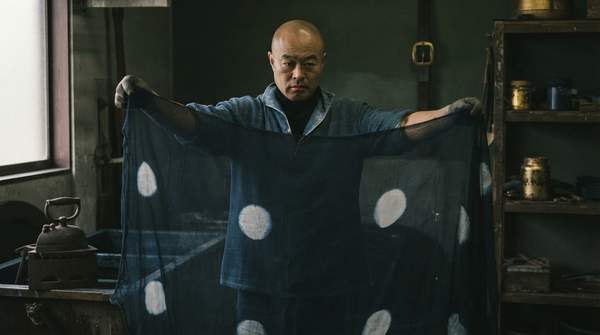
Shibori resists translation. Textile scholar Yoshiko Iwamoto Wada, president of the World Shibori Network, notes there is no English equivalent for the word, which comes from the Japanese verb root shiboru—"to wring, squeeze, press." The closest rendering is "shaped-resist dyeing": rather than treating cloth as a flat surface, the maker gives it three-dimensional form by folding, crumpling, stitching, plaiting, or plucking and twisting. The reserved areas record themselves as patterns with characteristically soft edges and crinkled textures when the cloth is dyed.
The why is equally eloquent. The Museum of Fine Arts Boston traces the technique's earliest Japanese examples to the Nara period (710–794), but its popularity arrived roughly a thousand years later, in the Edo period (1615–1868), when laws restricted the cloth and colors non-royalty could wear. Indigo—and later shibori itself—became the popular answer, used to dye kimonos, yukatas, and even handkerchiefs. Constraint, in other words, produced creativity: ordinary people found intricate beauty within the boundaries the law allowed.
The aesthetic completes the reading. Because the final result cannot be predetermined, variations and imperfections are accepted as they come and seen as beautiful—an embodiment of traditional Japanese sensibility. Named pattern types such as itajime, kumo, and kanoko shibori each pursue this quality differently, and the spiderweb-like Tekumo shibori of Arimatsu, near Nagoya, developed over 400 years ago, represents one of its most refined expressions.
Malian Mudcloth (Bogolanfini): Earth's Wisdom in Fabric
Bogolanfini inverts the emphasis: here the what and the why dominate. The cloth is traditionally made by painting patterns with fermented mud onto hand-spun cotton, yielding striking geometric designs in earth tones. The technique is remarkable—dirt transformed into durable ornament—but the deeper story is written on the surface.
As a cultural overview from Nwami International Malta explains, the geometric patterns often carry symbolic meanings, telling stories of local folklore, social status, or personal journeys. The cloth is typically worn during important life events and is considered a medium of cultural communication in Mali. A single garment can thus function as biography, social marker, and communal memory at once.
This is the framework's third lesson, and perhaps its most important. Where batik's meaning is procedural and shibori's is philosophical, mudcloth's is declarative: the pattern is the text. The specific proverbs and historical episodes encoded in particular symbols belong to Bamana tradition and exceed what a general introduction can convey—but the principle stands. The reader who asks "what do these marks say, and on what occasion is this worn?" is reading bogolanfini exactly as it was meant to be read.
Unraveling the Threads of Heritage: Your Next Steps
To deepen your appreciation of global textile heritage, apply the three-part framework to other traditional patterns you encounter, focusing on their creation process, symbolic language, and cultural context. Ask how the cloth was shaped, what its motifs depict, and why it was made at all. The test of the framework is simple and measurable: the reader can identify and articulate at least one aspect of technique, symbolism, and cultural use for a newly encountered traditional textile pattern. When you can do that for a cloth you have never seen before, you are no longer looking at fabric—you are reading it.
Sources
- What's The Actual History Of Your Favorite Fabric Patterns? + Where To… — Emily Henderson
- Shibori
- Shibori — Museum of Fine Arts Boston