Preserving an heirloom garment comes down to two decisions made correctly: how you store it—flat, rolled, or boxed—and what you store it with. Textile conservation guidance from university extension services and museum conservators converges on a clear principle: the method must match the garment's fabric, weight, and condition, and the materials must be archival. Perhaps just as important, two of the most familiar "traditional" solutions—the cedar chest and the plastic garment bag—should be retired from heirloom care entirely. Here is how to make the right choice for your garment.
Understanding Your Heirloom: Fabric Type and Condition
Before any garment is put away, it needs an honest assessment, and that assessment begins with fiber. The University of Georgia's textile extension guidance frames the decision plainly: there are three ways to store textiles—flat, rolled, or on a hanger—and the choice should reflect "the type and condition of the textile and space available." Fabric type matters because protein fibers such as silk and wool respond to their chemical environment differently from cellulose fibers such as cotton and linen, a distinction that determines even which tissue paper is safe to use.
Condition is the second axis. A garment that is visibly soiled, mold-affected, brittle, or stained calls for a qualified textile conservator rather than a conventional cleaner, as preservation writer Jurate Luckaite of Violeta Lucce notes; conservation aims to stabilize an object, not erase every trace of age. That distinction protects the garment's value, authenticity, and the hand of its original maker. Fragility also shapes storage: creases can split fragile fabrics, so any method that sets sharp folds in weakened cloth is itself a form of damage.
Weight and construction complete the picture. Heavy skirts, beadwork, and metallic embroidery should be supported from below, never left to hang for years, because sustained tension pulls at seams and distorts embellishment. Decorative elements—sequins, beads, lace, pearls, and hand embroidery—require careful handling in any configuration, as the preservation guide from Vanzoo emphasizes when discussing specialized treatment for delicate fabrics.
The Archival Advantage: Choosing the Right Materials
The single most consequential material choice in heirloom storage is between buffered and unbuffered acid-free tissue, and it is a choice many people never realize they are making. The distinction is chemical: buffered tissue contains an alkaline reserve, typically added to neutralize acids, which suits stable cellulose fibers such as cotton or linen. Unbuffered tissue carries no such reserve, which matters for protein-based fibers.
The rule of thumb, laid out by the Violeta Lucce preservation guidance, is to line storage with acid-free, unbuffered tissue when storing silk, wool, leather, or textiles with uncertain dyes. Buffered tissue is often suitable for cotton or linen, but it is not the best default for every material. When in doubt about a garment's dyes or fiber blend, unbuffered is the safer choice.
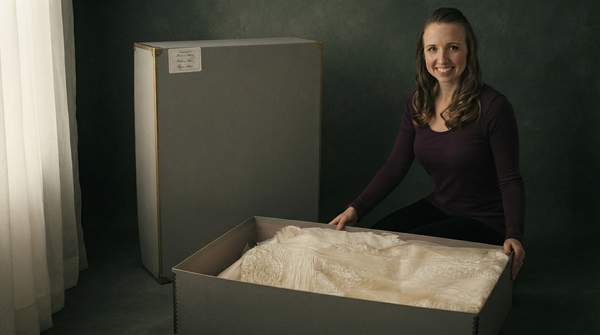
Tissue also does physical work. Layers should be placed between folds, beneath sleeves, inside bodices, and under embellishment so sharp creases do not set; curves should be gently padded rather than compressed. The University of Georgia guidance adds a household alternative for padding folds: crumpled tissue paper or unbleached, washed muslin, using as few folds as possible. For boxed storage, an archival-quality acid-free box is preferable to a hanger for most heirloom garments, chosen large enough that the garment can rest with minimal folding.
Heirloom Garment Storage Decision Framework
Work through the questions below in order. Each step eliminates unsuitable options until a single storage configuration remains, matched to your garment's fabric, size, and condition.
| Step and question | If yes | If no |
|---|---|---|
| 1. Is the garment a large flat textile—a quilt, banner, or length of fabric? | Go to rolled storage (Step 2). | Go to Step 3. |
| 2. Rolling check: is it single-layer and unembellished, or a pile, embellished, or multilayer fabric? | Roll it—face-out for pile, embellished, and multilayer fabrics, in the direction of the strongest element (generally the warp). Use mailing or fabric tubes for small lightweight textiles; roll on a table the width of the textile, not too tightly, to avoid creasing. | Consider mat storage for smaller, awkwardly sized, or more fragile textiles, especially fragments. |
| 3. Can the garment lie flat without folding? | Flat storage is considered the best method. Use an archival-quality acid-free box or a large metal map cabinet with drawers large enough for minimal folding and smooth operation. | Use boxed storage with padded folds: pad with crumpled acid-free tissue or unbleached, washed muslin, using as few folds as possible. |
| 4. Is the fabric protein-based (silk, wool, leather) or are the dyes uncertain? | Line the box with unbuffered acid-free tissue. | For stable cellulose fibers such as cotton or linen, buffered tissue is often suitable. |
| 5. Is the garment heavy, beaded, or metallically embroidered? | Support it from below in the box; never leave it hanging for years. | Proceed with the configuration above. |
The result of this sequence is a specific configuration—for example, a beaded silk wedding dress resolves to: store flat in an archival box lined with unbuffered tissue, padded at the folds and beneath the beadwork, supported from below. A cotton quilt in sound condition resolves to: rolled face-out on a fabric tube, or folded in a large buffered-tissue-lined box if rolling is not an option.
Two refinements from conservator guidance strengthen the framework. The Textile Specialty Group's conservation wiki cautions that rolling more than one textile on a tube is not recommended, because it requires additional handling and limits access. And the George Washington University Museum and The Textile Museum warns against using polyvinyl chloride tubing—PVC pipe—as the roll support, because the material gives off damaging chemicals as it breaks down.
Common Storage Mistakes to Avoid
The cedar chest occupies a cherished place in family lore, which makes its fall from grace all the more important to state clearly. While cedar may deter some insects, its oils and strong scent are not appropriate for long-term contact with delicate fibers, according to the Violeta Lucce guidance, which lists cedar chests alongside attics, basements, garages, and exterior walls as places to avoid. The very property that made cedar seem protective—its aromatic oils—is what threatens the textile over time.
Plastic garment bags fail for the opposite reason: they seem protective but trap moisture and restrict airflow, as Vanzoo's preservation guide explains. A sealed plastic environment invites the damp conditions in which mold and mildew take hold, and it offers the textile no way to breathe.
Environment deserves equal attention. The safest storage environment is cool, dark, clean, and stable, and a sudden swing in temperature or humidity is harder on textiles than a consistently moderate room. Hanging is the final habit to break: for most heirloom garments, an archival-quality acid-free box is preferable to a hanger, because years of hanging let gravity do quiet, cumulative damage to shoulders, seams, and embellishment.
Preserving Your Legacy: A Lasting Commitment
The decision, then, is to implement a tailored archival storage plan for each heirloom garment, selecting the method and materials based on its specific fabric type, condition, and construction: rolled for large flat textiles, flat or boxed storage with padded folds for garments, unbuffered tissue for silk, wool, leather, and uncertain dyes, buffered tissue for cotton and linen, and no cedar, plastic, or long-term hanging anywhere in the plan.
Success is measurable. The indicator is simple to check on an occasional inspection: the garment remains free from new yellowing, mold, mildew, creasing, or structural degradation over time. If those signs appear, something in the configuration—environment, materials, or method—needs to change. What this article does not cover is major repair or restoration, which belongs with a professional textile conservator, as does any garment already showing mold, brittleness, or staining. Storage preserves what time has left; the conservator's bench is where damage itself is addressed.
Sources
- Heirlooms — SITE
- Heirloom Garment Preservation: How to Store and Protect Family Clothing for Generations — Vanzoo
- How to Preserve Heirloom Garments with Care — Violeta Lucce
- TSG Chapter VIII. Storage of Textiles — Conservation Wiki