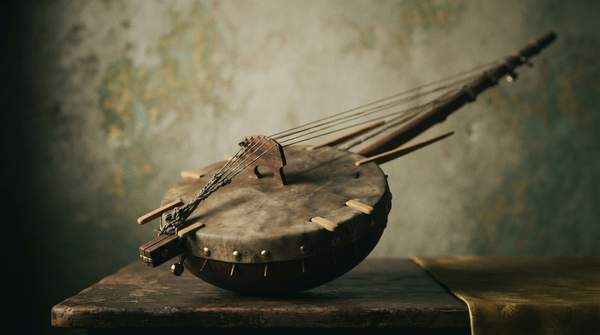
The fastest way to distinguish a kora from an ngoni is to look at the neck. A kora's long hardwood neck passes right through its large calabash resonator and supports twenty-one strings arranged in a harp-like plane, while an ngoni is a lute: a slimmer wooden or gourd body with a straight neck inserted into it and far fewer strings. Their histories diverge just as sharply. The ngoni is among the oldest documented stringed instruments in West Africa, appearing in the writings of the Arab traveller Ibn Battuta in 1352, whereas the kora's estimated development lies around the fourteenth century and its first European mention came only in 1799, describing an eighteen-string version.
Introduction to West African Stringed Instruments
Both instruments belong to the broader Mandinka cultural world, a people whose own histories trace their origins to the Mali Empire and who live across a wide sweep of the continent. Yet the two instruments occupy different organological families and different social niches. The kora, though played today in Guinea, Guinea-Bissau, Mali and Senegal, was first documented in the Gambia, and it is inseparable from the jali — the hereditary historians, genealogists and storytellers who pass their skills to their descendants. The ngoni, by contrast, spreads across a wider set of roles, from everyday melody-making to specialized ceremonial functions.
That distinction matters because casual descriptions often blur the two. Both can have skin-covered resonators, both are plucked with the fingers, and both carry the weight of oral tradition. But their construction, their documented timelines and their musical mechanics follow separate paths, and understanding those paths is the key to appreciating each instrument on its own terms.
The Kora: A Harp of the Jali Tradition
The kora's resonator is typically a large calabash — a pumpkin-like gourd — cut in half and covered with cow skin, a construction that gives the instrument its distinctive warm resonance. Its long hardwood neck passes entirely through the resonator body, a through-neck design that anchors the harp-like arrangement of strings rising from a tall bridge. Traditional koras carry twenty-one strings, eleven played by the left hand and ten by the right.
Culturally, the kora is the voice of the jali. Most West African musicians prefer the term "jali" to "griot," the French word; "jali" means something close to a bard or oral historian. Kora players have traditionally come from jali families among the Mandinka tribes, so the instrument is not merely a musical tool but a vehicle for genealogy, praise and historical memory handed down through generations.
Its documented history is comparatively late. The earliest European account describes "the korro, a large harp with eighteen strings," and over the course of the nineteenth century drawings, museum acquisitions, photographs and postcards traced its evolution toward the modern form. Scholars note that the kora bears a striking resemblance to similar harps with calabash resonators in the region, and conclude that it likely developed as an evolution of those earlier harps — though oral traditions may point to older roots than the written record can confirm.