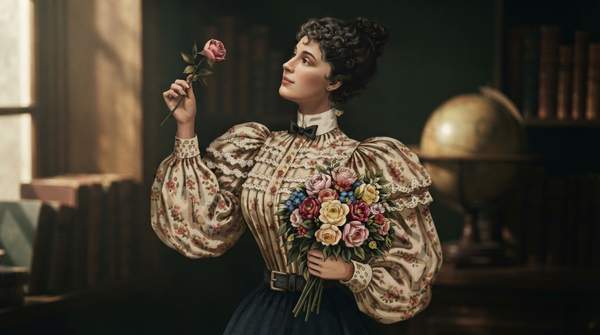
In the Victorian era, a bouquet was never just a bouquet. Between roughly 1837 and 1901, people across England, North America, and France used an elaborate symbolic system — floriography, the "language of flowers" — to send coded messages of love, rejection, flirtation, and grief that strict social etiquette forbade them from saying aloud. A red rose declared love; a yellow rose accused infidelity; and the hand used to present a bloom could flip its meaning from "yes" to "no."
The Silent Language of Victorian Floriography
The system worked because it was silent and selective. As the Living History Farms blog explains, a bouquet in this period became "a secret message, and one had to know the meanings of the flowers that composed it in order to decode it." Only someone familiar with the floral vocabulary could read the intent behind a gift of blooms, plants, or a specific arrangement. This mattered because Victorian social convention imposed severe restrictions on what could be expressed directly — especially in courtship — so flowers became a discreet channel for feelings that could not be spoken. The result was a communication system understood by those "in the know," allowing senders to convey romance, devotion, jealousy, or rejection without ever voicing the words.
Origins and Popularity of the Language of Flowers
Floriography did not begin with the Victorians. The first recorded instance of a structured floral language appeared in the early eighteenth century, when Lady Mary Wortley Montagu observed that women in Turkish sélams used flowers to pass along messages. The decisive codification came in 1819, when Le Langage des Fleurs — the first dictionary to explain the meanings behind various flowers — was published in Paris. Its code became extremely popular with the middle and upper classes of Victorian society, who were bound by strict etiquette.
In England, the clergyman and flower writer Robert Tyas (1811–1879) published The Sentiment of Flowers; or, Language of Flora in 1836, billed as an English version of Charlotte de la Tour's book; it was reprinted by various publishing houses at least through 1880. Interest in floriography soared across Victorian England, North America, and France throughout the nineteenth century.
Meanings were often drawn from a flower's nature. The mimosa symbolised chastity, for instance, because its leaves close up at night or when touched — behaviour that Victorians mapped onto the conduct of a chaste person.