Kōdō, Japan's "way of fragrance," is the art of listening to incense rather than merely smelling it. That single word choice defines the whole tradition. What arrived in Japan as a Buddhist devotional offering gradually evolved, over roughly a millennium, into a codified meditative discipline—formalized in the Muromachi period (1336–1573) and refined into its present-day basics during the Edo period (1603–1867). Understanding that journey, from prayer smoke to contemplative art, is the key to understanding what Kōdō actually is.
The Ancient Roots: Incense Arrives in Japan
Incense came to Japan with Buddhism, through what incense makers Nippon Kodo and Kōju describe as "incenses for prayers"—materials used for religious ritual rather than pleasure. One widely repeated account traces the tradition's symbolic starting point to 595 AD, when agarwood, the resinous heartwood at the center of Kōdō's finest materials, was first discovered. In these early centuries, incense belonged to the temple. Its purpose was devotional, its meaning religious, and there was as yet no question of it being an art form anyone might study.
What matters about this origin is what it contrasts with. The idea that fragrance could be savored, compared, and reflected upon had to be invented—and it took centuries. Only around the end of the Muromachi period, after roughly 1,500 years in Japan, did incense use begin to develop into the distinct practice we now call Kōdō.
Heian Period: Incense as a Courtly Art
The first transformation happened in the Heian period (794–1185), when incense moved from the altar into aristocratic life. Incense appeared in poems, diaries, and court etiquette, a sign of how deeply scent had entered the culture of the nobility. Courtiers used it to scent their clothing and rooms, and competitive incense games emerged as sophisticated pastimes.
Aleksandra Werner, writing for the incense seller KENKAWAI, describes the practice of perfuming kimonos as a way of creating a personal aura that lingered after its wearer had left a room. Fragrance, in other words, became a signature of refinement and status. I find this the pivotal moment in incense's cultural history: scent was no longer only an offering to the divine but a language of taste among people.
Muromachi Period: The Birth of Kōdō and Formalization
The decisive shift came in the Muromachi period (1336–1573), when appreciation of incense became formalized and people began to practise mon-kō—listening to incense. That, as one historical account puts it, is the moment incense shifts into Kōdō proper. The practice joined the Japanese tea ceremony (sadō) and flower arrangement (kadō) as one of the classical arts of refinement, and acquired the rules and manners that define a geidō—a refined art performed according to established form.
Nippon Kodo's cultural account notes that as these formalities took shape, Kōdō ceased to be an "innocent pastime" and spread beyond the samurai and court classes. Writers, artists, and affluent merchants adopted its formalities, and incense went on to influence calligraphy, literature, and the tea ceremony itself, occupying what that account calls a precious position as an intangible, spiritual asset of the age.
Edo Period: Expansion and Accessibility
The basics of the art as passed down today were formed in the Edo period (1603–1867). This was the era of systematization: schools of practice emerged, new incense games were developed, and the graded classification of aromatic woods solidified. A piece came to be judged through its rarity, origin, and grade—criteria that still shape how it is received.
Accessibility broadened as well. What had been an elite pursuit became something the wider public could encounter, even if, as the Nagamochi Shop's beginner guide observes, Kōdō never achieved the popular reach of tea ceremony or ikebana. It remains the most intricate and least widely known of the three classical arts—revered among connoisseurs of Japanese aesthetics, and now, according to Kōju, attracting renewed international attention as ceremonies are held overseas.
Kōdō's Journey: A Historical Timeline
Read this table as the arc of the whole art: each row marks a stage in incense's transformation, and the sequence shows how a religious practice became a philosophical discipline.
| Period | Key Development | Cultural Context |
|---|---|---|
| 6th century (595 AD by tradition) | Incense introduced to Japan with Buddhism; agarwood discovered | Used for prayers and religious ritual, not aesthetic appreciation |
| Heian period (794–1185) | Incense becomes a courtly art of refinement | Scented clothing and rooms; incense games; fragrance in poetry, diaries, and etiquette |
| Muromachi period (1336–1573) | Appreciation formalized; practice of mon-kō established; Kōdō codified as a geidō | Shift from general incense use to a distinct art; joined tea ceremony and flower arranging as classical arts |
| Edo period (1603–1867) | Basics of the art formed; schools and new games developed | Spread beyond samurai and court to merchants, writers, and artists; influence on calligraphy, literature, and tea ceremony |
The pattern the timeline reveals is consistent: each stage removes incense one step further from utility and one step closer to contemplation. Prayer gave way to status; status gave way to form; form gave way to listening.
Monkō: The Philosophy of 'Listening' to Incense
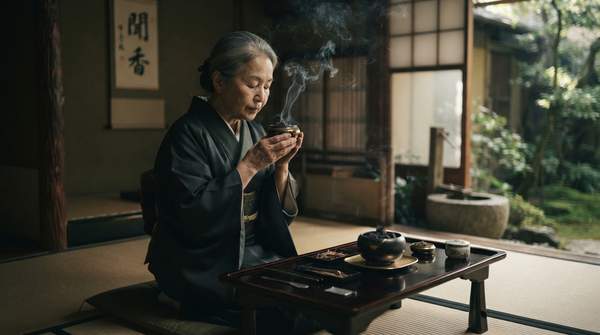
Monkō literally means listening to what fragrances are telling you. The word is not poetic flourish—it is the discipline's organizing idea. Practitioners are invited to listen to incense rather than merely smell it, engaging with fragrance as an act of attentive reception rather than passive consumption. In formal practice, the aromatic wood is warmed rather than burned, treated as a gift from the heavens, and its subtle fragrance is listened to, as Kōju puts it, "with your heart." The practice is also called fragrance appreciation.
What does listening actually mean? The ceremonial setting gives a clue. A kōmoto, or incense master, guides participants through the experience, which may include comparison games such as kumikō, where guests identify different blends or rare woods like kyara, a prized grade of aloeswood. These games sharpen memory and discrimination, but they sit inside a contemplative atmosphere; the listening is directed inward as much as outward—to one's inner state, not just the aroma. The concept of listening to aromatic wood, notably, eventually developed into those guessing games, showing how philosophy and play grew from the same root.
Mindfulness and Aesthetic Appreciation in Kōdō
The contrast with Western perfumery is where Kōdō's distinctiveness becomes clearest. Nippon Kodo's account states plainly that Japanese incense is "somewhat different from perfume in western countries." Where perfume aims at immediate sensory effect, Kōdō elevates fragrance into a form of spiritual practice, promoting mindfulness and inner clarity. The materials support this: where perfumes can overwhelm, the finest Kōdō materials—agarwood, sandalwood, cinnamon, camphor—unfold gently, subtle and layered, allowing the listener to immerse themselves over time.
There is also a craft dimension to the mindfulness. The wood is heated, not burned; gentle heat releases the scent without scorching, and even small shifts in temperature change how the aroma opens. Control of conditions becomes part of the attention itself. The reward, in Werner's framing, is a medium of self-discovery and serenity. In a world of distractions, as the Nagamochi guide observes, Kōdō offers a powerful exercise in mindfulness and sensory awareness—an ancient practice that continues to shape contemporary Japanese attitudes toward scent.
Embracing the Way of Fragrance
To fully appreciate Kōdō, one must engage with its core philosophy of Monkō and understand its historical evolution as a meditative and aesthetic practice—not as perfume, not as mere fragrance, but as a codified art of attentive reception that took a thousand years to form. This article has traced the history and philosophy; it is not a step-by-step guide to performing a ceremony, and it does not survey modern products or brands.
You can check your understanding with a simple, measurable indicator: the reader can identify and articulate the distinction between "smelling" and "listening" to incense, recognizing Kōdō's unique cultural and philosophical significance. If you can explain why practitioners warm rather than burn the wood, and why that attention defines the art, you have grasped what the long journey from temple smoke to Muromachi listening actually built.
Sources
- Incense ceremony and culture — Japanese incense and Fragrance Brands | Nippon Kodo
- Incense ceremony — KOJU
- Kodo History: From Nara Incense to the Muromachi Practice — Scento
- What Is Japanese Incense? A Beginner’s Guide to Its History and Uses — Nagamochi Shop
- Kodo: A Journey into the World of Japanese Incense — KENKAWAI