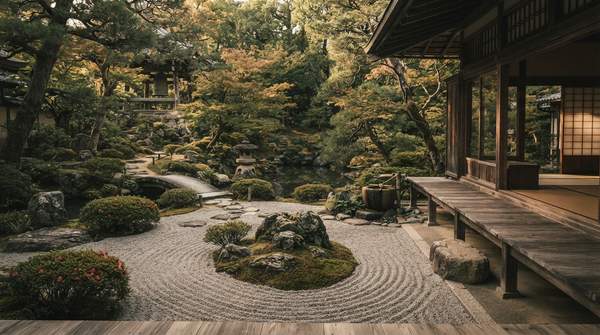
Traditional Japanese gardens fall into three widely recognized types: Tsukiyama (hill gardens), Karesansui (dry gardens), and Chaniwa (tea gardens). Each is defined by distinct physical elements and a distinct purpose: Tsukiyama gardens are built around hills, ponds, and streams meant to be walked and viewed; Karesansui gardens replace water with raked sand and carefully placed rocks for seated contemplation; Chaniwa gardens guide visitors along a stone path toward a teahouse in preparation for the tea ceremony. What unites all three is a shared ambition: not to copy nature, but to interpret it—to compose a space that invites a particular kind of attention, whether that attention is a stroll, a meditation, or a ritual.
Tsukiyama: The Hill and Pond Garden
Tsukiyama, the hill garden, is the style most closely tied to water. Its design centers on constructed hills, ponds, and streams, and it belongs to the broader family of stroll gardens that use water as the main feature, often in the form of a large pond. The related chisen-shukkei, or pond-and-spring design, is described by Art Design Asia as a design that marries the concepts of nature and manmade structures—one that has been used in Japanese gardens for centuries. In this sense, the hill garden is not a miniature of wilderness but a composed landscape: hills, water, and manmade elements arranged together as a single, walkable interpretation of nature.
Historically, these garden forms developed across successive Japanese eras. Botanic Gardens Conservation International traces garden development and restoration through the Nara period (710–794), the Heian period (794–1185), the Kamakura period (1192–1333), and onward through the Muromachi, Momoyama, Edo, Meiji, and Showa periods to the present. Within this long lineage, the pond-and-hill style served aristocratic estates and temple grounds alike, offering landscapes meant to be moved through rather than merely observed from one fixed seat. The garden's scale and its water feature are therefore its clearest identifying marks: where a Tsukiyama garden invites the body to travel through an interpreted landscape, the other two styles ask something different of the visitor.
Karesansui: The Dry Landscape Garden
Karesansui, the dry landscape garden—also known as a rock garden or waterless stream garden—inverts the hill garden's logic: it removes water entirely and evokes it instead. The main elements are rocks and sand, with the sea symbolized not by water but by sand raked in patterns that suggest rippling water. Flowing sand and gravel are used to represent seas or rivers, while rocks embody islands; arrangements can create miniature landscapes of streams, mountains, and islands, with some rocks even representing animals or other figures. Plants are much less important, and sometimes nonexistent.
These gardens are typically associated with Zen Buddhism and are often found in the front or rear gardens at the residences of Zen abbots, with Kyoto's Ryoanji and Daitokuji temples cited as representative examples. A karesansui is generally intended to be viewed from a single vantage point—a building or veranda opening—rather than walked through, and it is typically enclosed by walls, fencing, or formal hedging. Its restraint is the point: the garden represents the spiritualism of Zen Buddhism and provides a space and simplicity ideal for meditation. Where the hill garden immerses the visitor in water, the dry garden distills water into a pattern—asking the viewer to complete the landscape in the mind rather than the body.
Chaniwa: The Tea Garden
The Chaniwa, also called Roji, is a garden with a job to do: it prepares guests for the tea ceremony. It features a path, often of stepping stones, leading to a teahouse or small pavilion, and roji-style gardens are traditionally created on a narrow, long strip of land, guiding a walk from the house to the teahouse. The path is meant to represent the struggles of life, leading toward spiritual cleansing; Art Design Asia describes the small garden as symbolizing simplicity and tranquility amid complicated life situations. The garden is thus a threshold—a designed transition from the mundane world into a ceremonial one.
Tea gardens reached the height of their development during the Azuchi-Momoyama period (1573–1603), when tea masters refined their design by embodying them with the spirit of wabi—rustic simplicity. The garden is typically divided into an inner and outer section, with guests using a stone basin for ritual cleansing when entering the inner garden through the middle gate, and stone lanterns providing both lighting and atmosphere. Even the stepping stones carry layered meaning: the Brooklyn Botanic Garden recounts that the tea master Sen no Rikyu (1521–1591) asserted stepping stones were sixty percent functional and forty percent aesthetic—a ratio his distinguished disciple Furuta Oribe (1544–1615) later reversed, by which point a tea garden without stepping stones was unthinkable.
Comparative Guide to Traditional Japanese Garden Types
The table below contrasts the three styles across their purpose, defining elements, and historical context, drawing together the characteristics described above into a single reference.
| Garden Type | Primary Purpose / Philosophy | Key Elements | Historical Context |
|---|---|---|---|
| Tsukiyama (Hill Garden) | Strolling and viewing; an interpretation of natural landscapes with water as the main feature, uniting nature and manmade structures | Hills, ponds, streams; a large pond as the central element | Developed through eras from the Nara period (710–794) onward, alongside the chisen-shukkei pond-and-spring style |
| Karesansui (Dry Garden) | Contemplation and meditation; represents the spiritualism of Zen Buddhism; viewed from a single vantage point | Rocks and raked sand or gravel symbolizing seas, rivers, mountains, and islands; little or no water; few or no plants; often enclosed by walls or hedges | Typically found at the residences of Zen abbots; representative examples include Ryoanji and Daitokuji in Kyoto |
| Chaniwa (Tea Garden) | Prepares guests for the tea ceremony; a journey from the mundane world toward spiritual cleansing, in the spirit of wabi | Stepping-stone path to a teahouse; inner and outer gardens; stone basin for ritual cleansing; stone lanterns | Peaked during the Azuchi-Momoyama period (1573–1603), refined by tea masters such as Sen no Rikyu and Furuta Oribe |
Read side by side, the comparison shows that the three types differ less in materials than in intent. Tsukiyama uses real water for immersion, Karesansui uses symbolized water for stillness, and Chaniwa uses a path for transition. Each style answers the same question—how should a person meet nature here?—with a different posture: walking, sitting, or proceeding toward a ritual. This article covers the three most commonly cited types; regional and historical variations lie beyond its scope, and the history summarized here rests on secondary sources as an introduction to a complex subject.
Recognizing the Spirit of Japanese Gardens
To fully appreciate a traditional Japanese garden, observe its primary elements—hills, water, rocks, sand, teahouse—and consider whether it invites strolling, quiet contemplation, or a ceremonial journey. The measurable test: when you next encounter a Japanese garden, you should be able to correctly identify whether it is a Tsukiyama, Karesansui, or Chaniwa garden and articulate its intended philosophical purpose. The diagnostic boundaries are straightforward. If the garden has a pond and hills to walk among, it is Tsukiyama; if it has raked gravel and rocks viewed from one seat, it is Karesansui; if a stone path leads to a teahouse, it is Chaniwa.
Sources
- The many beautiful designs of Japanese Gardens - Art Design Asia
- An insight into Japanese gardens in Japan — Botanic Gardens Conservation International
- Gardens in Japan; Karesansui (Dry Landscape, Rock Gardens) and Tsukiyama (Hill Gardens) — Onmarkproductions
- Authenticity in Japanese Landscape Design - Brooklyn Botanic Garden