Traditional Japanese gardens are meticulously crafted landscapes that serve as artistic representations of nature, but their forms and functions are deeply rooted in distinct historical and philosophical traditions. These serene spaces are broadly categorized into three primary types: Tsukiyama (hill gardens), Karesansui (dry gardens), and Chaniwa (tea gardens). Each style employs elements like stone, water, and plants in a unique way to create an environment for a specific purpose, whether for the aesthetic pleasure of aristocrats, the quiet meditation of monks, or the spiritual preparation for a sacred ceremony.
The Evolution of Japanese Garden Styles Through History
The design of Japanese gardens has transformed over centuries, mirroring significant shifts in the nation's culture, religion, and centers of power. The earliest major developments took place during the Heian period (794–1185), when Japan’s imperial court flourished. Influenced by Chinese ideals, aristocrats constructed grand pond gardens with islands, bridges, and elegant pavilions. These landscapes were not merely for viewing; they were stages for poetry, rituals, and seasonal enjoyment, reflecting both the owner's status and a desire for harmony with nature.
A dramatic aesthetic shift occurred as power moved from the court nobility to the warrior class during the Kamakura (1185–1333) and Muromachi (1336–1573) periods. The introduction and rise of Zen Buddhism inspired a more restrained and abstract style, giving birth to the Karesansui, or dry landscape garden. These stark compositions of stone and gravel were designed to encourage deep introspection. Later, during the Momoyama period (1573–1600), the growing popularity of the Japanese tea ceremony led to the creation of Chaniwa, or tea gardens. These gardens were designed around a path, the roji, which served as a spiritual passage to the teahouse.
Tsukiyama: The Grandeur of Hill and Pond Gardens
Tsukiyama gardens are conceived as miniature, idealized versions of natural scenery. Their name, meaning "hill gardens," points to one of their core components: artificial mounds or hills that, along with ponds, create a dynamic and picturesque landscape. Developed for the leisure of Heian-period aristocrats, these gardens often represent famous landscapes in miniature. Water is a vital element, symbolizing life and renewal, with large central ponds often used for pleasure-boating.
The design of a Tsukiyama garden is meant to be appreciated from multiple perspectives. Viewers might enjoy the scenery from a pavilion overlooking the water or by following a path that reveals new vistas with every turn. Elements such as islands connected by bridges, waterfalls, and carefully placed stones and plants all contribute to a harmonious composition that captures the beauties of nature. These gardens are an expression of Shinto spiritualism's connection between the land and spirits found in nature, aiming to create a space of profound beauty and tranquility.
Karesansui: The Serenity of Dry Landscape Gardens
In stark contrast to the lush, water-filled landscapes of Tsukiyama, Karesansui gardens use abstraction to evoke the essence of nature without the literal presence of water. Often called "Zen gardens," these dry landscapes are powerful tools for contemplation. Instead of water, carefully raked sand or gravel represents oceans, rivers, or lakes, while meticulously placed stones symbolize islands, mountains, or even animals. The plantings are minimal, often limited to moss, which is used to suggest that the garden is ancient.
These gardens are not meant to be entered or walked through. According to Botanic Gardens Conservation International, their purpose is to facilitate meditation, and they are designed to be viewed from a fixed vantage point, such as the porch of a monastery's abbot. The most famous example is the garden at Ryōan-ji temple in Kyoto. The minimalism of Karesansui encourages quiet introspection, allowing the viewer to find deep meaning in the simple, powerful arrangement of stone and sand, a direct reflection of the restrained aesthetic introduced by Zen Buddhism.
Chaniwa: The Path to the Tea Ceremony
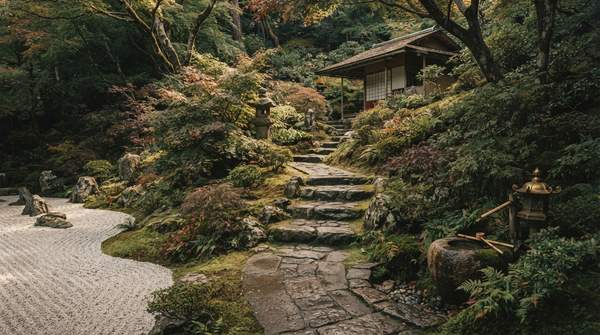
The Chaniwa, or tea garden, serves a highly specific and spiritual function as the setting for the Japanese tea ceremony, or chanoyu. Its design is centered on the roji, a path that leads guests from the outside world to the teahouse. This journey is intended to be a meditative experience, a retreat from the everyday that helps visitors shed worldly concerns and prepare for the ceremony. The path is deliberately rustic and naturalistic, designed to inspire a sense of tranquility and focus.
Key features along the roji are both practical and symbolic. Stepping stones are carefully laid to control the pace of the walk, encouraging mindfulness. Stone lanterns provide subtle light, and a stone water basin called a tsukubai is always present. Here, guests perform a ritual of purification by washing their hands and mouth with water provided by a bamboo pipe. This act completes the spiritual transition, preparing them to enter the teahouse. The carefully chosen plants, fences, and gates all contribute to a secluded atmosphere, separating the space from the outside world.
Comparative Guide to Traditional Japanese Garden Styles
To fully appreciate the unique beauty and cultural significance of each garden style, it is helpful to compare their defining characteristics directly. The following table breaks down the core purpose, key elements, and historical context of Tsukiyama, Karesansui, and Chaniwa gardens, highlighting their distinct roles in Japanese art and philosophy.
| Style | Core Purpose | Key Elements | Philosophical and Historical Context |
|---|---|---|---|
| Tsukiyama (Hill Gardens) | To represent a natural landscape, create harmony with nature, and provide aesthetic enjoyment for aristocrats. | Ponds, islands, bridges, artificial hills, stones, plants, and pavilions. | Developed during the Heian period (794–1185) with Chinese influences, reflecting Shinto spiritualism and aristocratic court life. |
| Karesansui (Dry Gardens) | To facilitate meditation and encourage quiet introspection through abstract compositions, meant to be viewed while seated. | Gravel, sand, and stones, with minimal or no water and sparse plantings like moss. | Emerged during the Kamakura (1185–1333) and Muromachi (1336–1573) periods, introduced by Zen Buddhism. |
| Chaniwa (Tea Gardens) | To prepare guests for the Japanese tea ceremony by guiding them along a spiritual path (roji) to the teahouse. | Stone water basins (tsukubai), stone lanterns, stepping stones, and carefully chosen plants for a secluded atmosphere. | Created during the Muromachi (1333–1573) and Momoyama (1573–1600) periods, influenced by the rise of the tea ceremony. |
Recognizing the Purpose Behind the Design
When encountering a traditional Japanese garden, observe its primary elements and overall composition to determine its style and underlying philosophical purpose. The design choices are not merely aesthetic; they are a direct reflection of the garden's intended role in cultural and spiritual life. By identifying these key features, you can gain a deeper appreciation for the artistry and meaning embedded in each landscape, understanding it not just as a beautiful scene but as a space with a specific function.
A simple way to distinguish the styles is by their most prominent features. The presence of a large pond and hills suggests a Tsukiyama garden, a landscape designed for scenic appreciation and strolling. An abstract composition of raked gravel and rocks for meditation indicates Karesansui, a space for static, inward-looking contemplation. Finally, a secluded path with a stone basin leading to a small structure points to a Chaniwa garden, a transitional space designed for ritual preparation and the cleansing of the spirit.
Sources
- Japanese gardens: History and symbolism – Interesting Japan — Interestingjapan
- Japanese garden - Wikipedia
- Japanese Garden History: From Courtly Ponds to Meditative Rock and Naturalistic Stroll Gardens - Real Japanese Gardens
- Japanese Gardens 101 - Part 1: The History of Japanese Gardens - Samurai Tours
- An insight into Japanese gardens in Japan — Botanic Gardens Conservation International